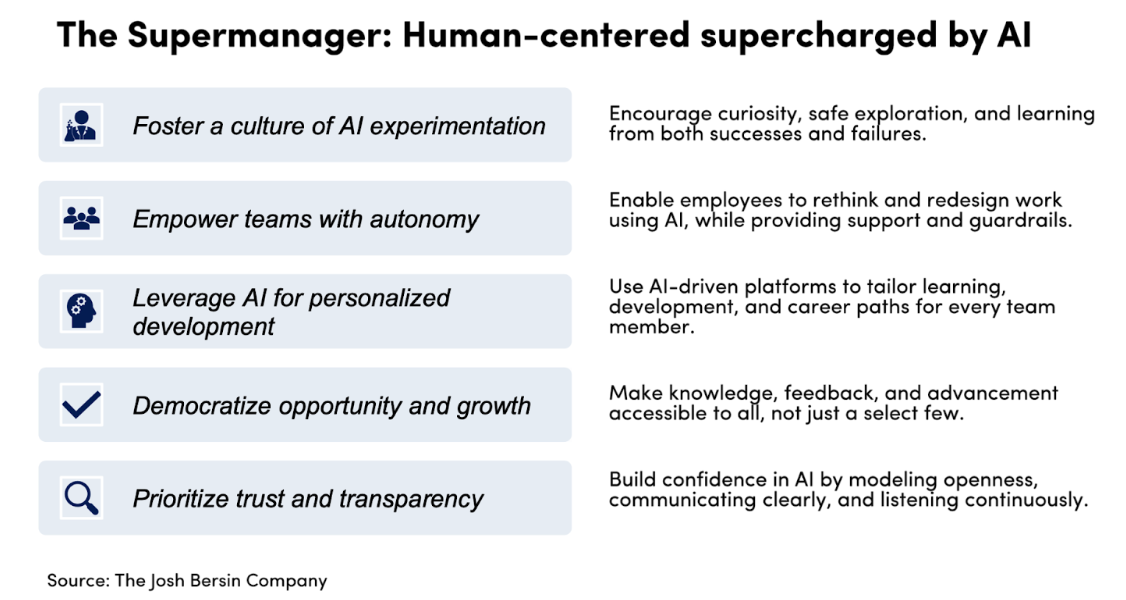
According to Gartner, managers are experimenting with AI at nearly double the rate of their employees. In the same research, 86% of those managers report struggling to drive AI adoption across their teams.
Image by Gerd Altmann from Pixabay
The gap between what organizations deploy and what managers can actually implement with their teams isn’t new—and it isn’t a technology problem. Every major workplace shift of the past decade has run into the same bottleneck. Remote work. Digital transformation. Hybrid models. Restructuring. In each case, organizations invested heavily in the what—the tools, the platforms, the processes—and underinvested in the who: the managers expected to make it all work.
Gartner has recommendations for closing the manager AI gap, and based on our client work, I think they’re spot on. Here are the capabilities your leadership development programs should be building right now and what they look like in action.
Read the Room, Not Just the Roadmap
The best managers don’t apply a one-size-fits-all approach to change. They pay attention to the dynamics on their teams—who is energized, who is anxious, who is quietly resistant and why. That kind of awareness can come only from taking the time to know your people.
This matters more with AI adoption than with almost any previous change initiative. AI touches how people think about their own value and capabilities. Concerns about job security, cognitive decline and the erosion of meaningful work are real—and they show up differently on different teams. A manager who leads purely from the roadmap misses all of that.
Effective development programs should equip managers to tailor their communication and support based on what their people actually need. That means understanding how to have honest conversations about AI’s role, building psychological safety so team members can raise concerns and customizing development in ways that build capability without deepening anxiety or becoming just one more thing to do.
Lead Through the Emotional Side of Change
When people push back on a new tool or process, they’re usually telling you something important—about trust, about workload, about what they fear losing. Managers who treat resistance as an obstacle to manage will miss that signal entirely. Managers who treat it as data will learn something useful.
This is where emotional intelligence becomes indispensable. As I’ve written before, change fatigue is eroding the very leadership capabilities that matter most in uncertain times. When managers are stretched thin—managing their own learning curves on top of their teams’—their emotional reserves run low. That’s when they’re most likely to miss cues, rush past discomfort or default to command-and-control behaviors that undermine trust.
Building resilience and courage in managers is the foundation that makes everything else work. Managers who can stay grounded under pressure, acknowledge the weight of what their teams are carrying and create space for honest conversation are the ones who actually move adoption forward.
Equally important: Managers need to be able to help their teams anchor on purpose. When change feels relentless, people need a clear line of sight into why it matters. Managers who can connect AI adoption to meaningful work—rather than just rolling out the tool—are the ones who bring people along.
Connect the Dots for Leadership
Most managers understand the strategy behind the decisions being made above them. Most of their teams don’t. And the gap between those two realities is where change initiatives often stall.
Communicating value upward—and connecting the dots between organizational strategy and day-to-day work—is a skill that most managers were never explicitly taught. One of the most powerful shifts I've seen in my work with leaders is when they learn to make this connection visible. When a manager can explain not just what is changing, but why it matters, how it connects to the bigger picture and what it means for the people on their team, something changes. Engagement picks up. Resistance softens. Trust builds.
This is also true in the other direction. Managers who can clearly communicate what they’re observing on the ground—what’s working, what isn’t, what their teams need—become invaluable strategic partners to senior leadership.
The Opportunity: Redirecting Freed-Up Capacity
There’s one more piece of the Gartner data I’m paying special attention to. As AI begins to deliver on its efficiency promises, it will free up time and cognitive capacity that currently goes toward routine tasks. So what happens to that capacity?
Left unaddressed, freed-up time tends to get filled with more of the same—more meetings, more administrative work, more reactive noise. The opportunity—and the risk—is significant. If managers aren’t equipped to help their teams redirect that energy toward higher-value work, the productivity gains AI promises will get absorbed rather than realized.
This requires managers who can think strategically about priorities, help their people identify where they can create the most impact and create the conditions for meaningful work to actually happen. That’s not something AI can do for you. It’s exactly what strong managers do.
How We Develop the Managers AI Adoption Needs
Everything Gartner identifies as critical for driving AI adoption—emotional intelligence, change agility, strategic communication, the ability to build trust and influence—is exactly what our products and services were designed to develop.
Take our leadership development platform, New Lens®. It’s built for today's workplace: complex, fast-moving and full of competing demands. It delivers development in the flow of work, scales across entire organizations (not just high-potential cohorts) and builds the human capabilities no AI can replicate.
Our clients use New Lens to equip their managers with the skills to lead through transitions: reading organizational dynamics, communicating with clarity and empathy, building resilience in themselves and others, and connecting strategy to action in ways that actually land.
To learn more about how New Lens and our other solutions can prepare your managers for this moment, request a demo or reach out directly. We'd love to talk.
Don’t wait for performance to drop before taking action. Discover how the New Lens® platform helps organizations support managers with bite-sized, actionable learning—built for today’s fast-paced, high-stress environments.