
Women and Burnout: Why It Happens, What to Do

This Women’s History Month, I can’t help but think about all the women leaders who are exhausted but still showing up. Who are carrying more than their share and wondering if anyone notices. Who love their work but aren’t sure how much longer they can sustain this pace.

Image by Pexels from Pixabay

To those leaders: I see you. 

Your fatigue is real, and it’s not a personal failing—it’s a systemic issue that organizations need to address. In one recent survey, 75% of women reported experiencing burnout at work, compared with 58% percent of men. Sixty percent of senior-level women report frequent burnout, compared with 50% of senior-level men. For Black women in senior leadership, that number climbs to 77%.

To the executives and HR leaders reading this, the burnout gap won’t close on its own. And it’s costing your organization dearly. You’re losing talent, engagement, and the leadership pipeline you’ve worked so hard to build.

So, as we celebrate women in March, we also must take a hard look at the barriers to women’s progress. The burnout crisis is one of the most serious obstacles women face, but also one where we can take decisive action.

Why Burnout Hits Women Harder

What’s behind these numbers? First, there are key factors driving burnout for men and women: stressful work environments, pressure from growing workloads, expectations to be constantly productive, stagnating wage growth and not enough mental health support.  Second, women face unique challenges that increase the risk of them feeling unprepared or overwhelmed in their roles:

  1. Women receive less actionable feedback than men—and less feedback overall. One analysis found that women get twice as many vague, unactionable critiques in performance reviews as their male colleagues, and are more than 20% less likely to receive the kind of difficult, specific feedback that actually helps people grow, learn and advance. 

  2. Women are less likely to be offered the stretch assignments and training opportunities that signal the organization’s investment in them and reinvigorate their career energy. Four in 10 entry-level women haven’t received a promotion, stretch assignment or leadership training opportunity in the past two years, and women are 12% less likely than men to receive leadership skills training.   

  3. Women experience the draining toll of microaggressions—being talked over in meetings, having their competence questioned, navigating double standards about leadership style. Women who experience microaggressions at work are four times more likely to report being almost always burned out. And women of color face these experiences at dramatically higher rates: Black women are nearly four times as likely as white women to encounter microaggressions, and Latinas and Asian women are two to three times as likely.

  4. Women often carry invisible labor that doesn’t show up on any performance review. Research shows that women in senior leadership do 60% more work than their male counterparts to support employees’ emotional well-being: mentoring junior colleagues, mediating team conflicts, noticing when someone is struggling. The culture-building work that organizations depend on falls disproportionately on women.

  5. Women still perform a disproportionate share of unpaid labor at home: Those who work full time still log 9.7 hours per week on household tasks, compared with 5.4 hours for men. Working mothers put in 63% more time than working fathers on childcare and housework each week. And beyond the physical work, mothers take on roughly 73% of all cognitive household labor—the never-ending work of planning meals, scheduling appointments and tracking what the family needs. When this “second shift” follows women into the office each morning, is it any wonder we are exhausted?

The #1 Misconception About Women and Burnout

We have to realize that burnout is not simply a result of individual choices. It is a systemic issue.

Far too often, we talk about women and burnout only in terms of what individual women can do on their own to recover. Addressing burnout at your organization involves more than, say, offering a weekly yoga class or a workshop on resilience.

That means that if your people seem burned out, examine workloads before you look for ways to build their stress management skills. Trust me, even the best training programs won’t be effective when your learners are just trying to keep their heads above water.

Workplace relationships are another systemic factor in burnout. Amid the rise of hybrid work and wave after wave of layoffs, it can feel harder than ever to form close connections to colleagues. More women than men feel isolated and lonely at work, and that fuels burnout.

Organizations also inadvertently fuel burnout by skimping on recognition. It’s easy to understand why: When we’re busy, praise and recognition can be among the first things to fall by the wayside. And—you guessed it—women get less recognition than men do.

How Development Can Address Women’s Burnout

As your organization examines structural issues that fuel burnout, you can start looking at how development opportunities fit into the equation. At Newberry Solutions, we’ve been working with high-performing women leaders since 2008, and we shape all of our products and services based on what really works.

Development must sustain, not drain. That’s why we emphasize teaching practical, immediately actionable strategies that focus on what matters most. We also created the New Lens® platform that empowers leaders to learn wherever they are, even when they have only a few minutes between meetings or in the school pick-up line. As one participant told us, “I feel like I’ve got four full-time jobs. What I love about New Lens is that I can work on it in between things in little spurts. It’s great how digestible this is—videos are two to seven minutes and the articles are short.”

To cultivate the relationships that benefit women so much, we offer development programs that integrate cohort learning, coaching and feedback, and build sponsorship—without taking too much time. All of this has the potential to fix the “broken rung” in women’s career advancement.

Empower Your Women Leaders

Since the turn of the decade, we’ve all been through enormous change, and disruption is only increasing. The period between now and 2030 will be unlike anything we have ever seen. Amid this dramatic transformation, there’s widespread anxiety about leadership pipelines. More than three-quarters of CHROs worry about their organization’s bench strength for key roles. 

In this environment, we just can’t afford to keep losing high-performing women to burnout. If this issue has been on the back burner at your organization, there’s no better time than Women’s History Month to move it forward. We love supporting organizations in advancing women in leadership—and we have an array of proven solutions to customize to your organization’s unique needs. Just drop us a note to open the conversation.


Don’t wait for performance to drop before taking action. Discover how the New Lens® platform helps organizations support managers with bite-sized, actionable learning—built for today’s fast-paced, high-stress environments.


Give to Gain: 5 Ways to Advance Your Career While Lifting Other Women

International Women’s Day is March 8, and this year’s theme is “Give to Gain”—a reminder that when we invest in other women, we all rise. It’s a message that resonates deeply with me. The most successful women don’t just focus on their own advancement. They lift as they climb. And in doing so, they gain more than they give.

Before we can give to others, though, we have to invest in ourselves. You can’t pour from an empty cup. So as you read through these six practices, I want you to think about them from two angles. First, how can you apply this to your own career? And second, who’s one person—a team member, mentee, or colleague—who could benefit from your support in this area?

1. Own Your Seat at the Table

For you: Recognize that you’ve already earned your current role. Pay attention to your executive presence: the messages you send about your confidence and authority. Stop waiting to feel ready. You’re here because you belong here.

If you’re still feeling some doubt, you’re not alone. About three-quarters of executive women have experienced imposter syndrome at some point in their careers. And the more you achieve, the worse it can get: Research shows that feelings of self-doubt often intensify rather than diminish with success. But here’s what I want you to remember: Those feelings of uncertainty aren’t facts. They’re a predictable response to stretching outside your comfort zone. Don’t let them keep you from taking up the space you’ve earned.

What you can give: Help another woman see that she’s already earned her seat, too. Women often discount their accomplishments or attribute success to luck. Be the voice that reflects her capabilities back to her—especially when she can’t see them herself. This is especially important if you’re the other woman’s manager: Employees are hungry for more coaching, and they often look to managers for a sense of purpose. (This is one reason we made sure that our New Lens® platform involves managers in employees’ development plans.)

Normalize talking about imposter syndrome; some women feel too embarrassed or isolated in their experiences to bring them up. You can also advocate for systemic change or address everyday behaviors that affect women’s sense of belonging or confidence (e.g., like the habit of interrupting women at meetings).

2. Invest in Sponsors, Not Just Mentors

For you: When you’re a busy manager, it’s easy to let relationship building take a back seat or assume that you’re past the stage of needing a mentor or a sponsor. But not having one can still hurt your career. You need people who will advocate for you when you’re not in the room. Mentors give advice. Sponsors open doors. Both are important, but sponsorship is what moves careers.

According to the 2025 Women in the Workplace study from McKinsey and LeanIn.Org, employees with sponsors are promoted at nearly twice the rate of those without. If you don’t have a mentor or sponsor, it’s never too late to cultivate those relationships.

What you can give: Be a sponsor for another woman. Bring her up for opportunities and educate others on her strengths. If she’s involved with a leadership development program, talk to her about how to apply what she’s learning within the specific context of your organization. If you’re not yet in a position to sponsor directly, make introductions to people who could sponsor her or give her opportunities to be in front of senior leaders. Access is one of the most valuable things you can give. You could even suggest starting a mentorship or sponsorship program at your organization.

3. Learn the Unwritten Rules

For you: Don’t shy away from office politics. Every organization has unwritten rules about how decisions get made, who has influence and what it takes to advance. Successful women learn to navigate these dynamics ethically—because ignoring them doesn’t make them go away.

“Playing the game” might feel harder these days if you’re working a hybrid schedule or you’re dealing with increased responsibilities. But that doesn’t make it less essential. So take a few minutes to think about a couple of important questions: Who has the resources, information and influence you need to get business results. And how can you get those people in your corner?

What you can give: Share the playbook with a woman who’s a rising leader or who is new at your organization. The unwritten rules are often invisible to people earlier in their careers—or to anyone who hasn’t had access to insider knowledge. Tell her what you wish someone had told you. Who really makes decisions? What does it actually take to get promoted here? This kind of knowledge can change a career trajectory.

You could make an even bigger impact for women at your organization by pushing for improvements in your onboarding process. Gallup has found that “only 12% of U.S. employees say their company does a good job of onboarding.” When companies miss the opportunity to facilitate relationships, learn new employees’ goals and get an early start on development, they hurt their pipeline of future leaders.

4. Ask for What You Want

For you: Negotiate. For the salary, the resources, the assignment, the flexibility. Here’s something that might surprise you: Recent research from UC Berkeley and Vanderbilt found that women with MBAs actually negotiate salary more often than men do. Yet women still earn less.

If you don’t like negotiating, or don’t think you’re not good at it, there’s probably more than one factor behind that feeling. Perhaps you feel constrained by cultural stereotypes that women are always accommodating. Or maybe you’re comfortable advocating for your team members, but not yourself.

I always share one simple tip that my clients say helps them get past their anxiety about negotiation: Beforehand, think about and prepare for how you might get in your own way. How have you reacted during negotiations in the past? What do you need to change this time to get the results that you want.

What you can give: Encourage another woman to negotiate for something she cares about—and coach her on how to do so. Share your own experiences, including the times it didn’t go perfectly and how you adjusted your approach. I’ve found that negotiation can be a powerful topic to explore in peer or cohort learning. Discovering that this is a shared challenge helps ease anxiety, and the chance to share wisdom helps everyone get better results in negotiations.

5. Make Your Impact Visible

For you: Have you always been a heads-down worker with the mindset that “I just need to do a good job and people will notice”? On today’s overloaded and distributed teams, just doing great work isn't enough anymore. Your contributions must be seen by the people who make decisions about your career.

Think of it this way: You're not bragging. You're helping others learn from your experience and successes. Someone else in your organization may be facing the same challenge you just solved, and sharing your results could help them tremendously. The mindset shift “promoting myself” to “sharing something useful” has been a light-bulb moment for so many of my executive coaching clients and users of New Lens.

What you can give: Create visibility for a woman you believe in. Mention her contributions in meetings. Forward her emails to senior leaders with a note about why her work matters. Recommend her for presentations or high-profile projects. At the same time, help her learn that self-promotion isn’t selfish. Let her see you tastefully highlighting your own wins, and share resources like the ones I’ve linked to throughout this article.

Give to Gain

In my work with clients and nonprofit board service, I’ve seen one thing hold true again and again: When women support women, everyone benefits. What you do has a ripple effect: The high-potential woman you guide today becomes the future leader who now has the chance to lift other women herself. It can all start with you, and we can help. Newberry Solutions has a special commitment to developing women leaders, and we have an array of products and services that fit the needs of women at every career stage. To learn more, just drop me a note.

P.S. Stay tuned here and on my LinkedIn page: We have more special content planned throughout Women’s History Month!


Don’t wait for performance to drop before taking action. Discover how the New Lens® platform helps organizations support managers with bite-sized, actionable learning—built for today’s fast-paced, high-stress environments.
The Development Strategy Gen Z Actually Wants

According to recent research, Gen Z has a concern about AI that might surprise you: cognitive decline. They fear that relying on AI could erode their intelligence, creativity and social connection. When I shared this finding with the HR and L&D leaders at our webinar last month, it was clear that attendees found this just as surprising as I did. 

Image by Aathif Aarifeen from Pixabay

Now, this doesn’t mean that Gen Z is anti-AI: Six in ten Gen Z’ers and millennials believe that career advancement requires AI skills. But they also understand that it’s not the be-all, end-all. Over eight in ten believe “soft” skills are required for their success. In other words, they want to develop their AI capabilities and protect their human ones. We also see this tension play out in our work with companies: Leaders want to equip their teams with AI skills, but they're also grappling with how to preserve the human capabilities that make great leadership possible.

As a company with a 17-year track record of helping leaders at top organizations build the confidence, capabilities and credibility to succeed, we believe this is one of today’s most significant trends in developing the employees who will become your bench of future leaders. Here’s how we’re guiding our clients in balancing AI and human capabilities in their L&D programs.

Humans Make Decisions; AI Helps

Strategic thinking is one of the most important leadership capabilities. But it’s also a common shortfall in development programs. A DDI survey found that just under two-thirds of leaders had received no training in setting strategy and managing change. It’s understandable these leaders would turn to AI for help, but how they do so can make all the difference. 

As we coach our clients on strategic decision-making, we talk about how this is an area that can’t be outsourced to AI. But AI can help with the process by asking clarifying questions, speeding up research and revealing blind spots. We recommend development programs that teach your Gen Z employees the fundamentals of strategic thinking, such as seeing the big picture and focusing on the right work, paired with technical training on how to engineer prompts that maximize AI’s potential as a thinking partner.

Get Deliberate About Building Human Skills

More than eight out of 10 managers say Gen Z employees need more help with skills like critical thinking, creativity, emotional intelligence, interpersonal connection and resilience than they’re currently getting. These are the kind of richly human capabilities that can’t be mastered just by watching a YouTube video or asking AI for advice. Instead, we learn these human skills by, well, being around other humans, and Gen Z’ers are at a disadvantage compared with earlier generations. Coming of age during the pandemic robbed them of social interactions, and the rise of remote work means they don’t have as many opportunities to learn “by osmosis” from colleagues as you and I did. 

Gen Z employees seem well aware they need to make up some ground in their human capabilities. They feel isolated by technology and want more in-person time, including in-person development opportunities. If AI training dominates your L&D budget right now, you can still give Gen Z’ers the face-to-face learning they crave through cohort learning, mentoring and manager coaching.

A Generation Ready to Lead — With the Right Support

While there’s an urgent need for training that gives Gen Z the technical and human skills they need to become tomorrow’s leaders, we’re so optimistic about this generation’s potential to reshape the workforce and the world. They have a healthy approach to AI—one that involves neither running from it nor blindly embracing it. And they are eager for chances to learn the human elements of leadership. When we provide development opportunities that align with their needs, we unleash the full potential of Gen Z’s strengths: collaboration, flexibility, pragmatism and authenticity.

Empowering this new generation of leaders must be one of your top priorities. The recent Brandon Hall Group HCM Excellence Conference drove home just how quickly things are changing—and how some organizations are far more ready for these changes than others.

How is your organization keeping pace? At Newberry Solutions, we have a suite of products and services to help cultivate future-ready leaders. We know that technology and person-to-person learning should work hand in hand to provide the development employees want while also driving business results. Contact us to learn more.


Don’t wait for performance to drop before taking action. Discover how the New Lens® platform helps organizations support managers with bite-sized, actionable learning—built for today’s fast-paced, high-stress environments.
Manager Development: Your Most Important L&D Investment

Organizations are demanding faster results, greater productivity and accelerated transformation. At the same time, employees need more support, more development, more connection and more purpose than ever. Caught in the middle? Managers.

We’re asking managers to drive results with smaller teams, lead people through constant change, create psychological safety in high-pressure environments, provide meaningful feedback, foster experimentation with AI tools and deliver on performance goals—often without the training, time or support to do any of it well. It’s no surprise that manager engagement sits at only 27%—a 10-year low.

If you’re an HR leader shaping your L&D plans for this year, this is the pressure point that deserves your attention.

The Expanding Manager Role

As I talk to L&D leaders and CHROs, the same themes keep emerging. In our recent webinar, I shared how important it is today for managers to create psychological safety as the business environment and definition of success continue to change.  Managers must also make everyday choices to delegate more meaningfully—not just to get tasks off their plate, but to genuinely grow their people. 

The convergence of these expectations complicate the role of managers, along with the push to constantly do more with less.

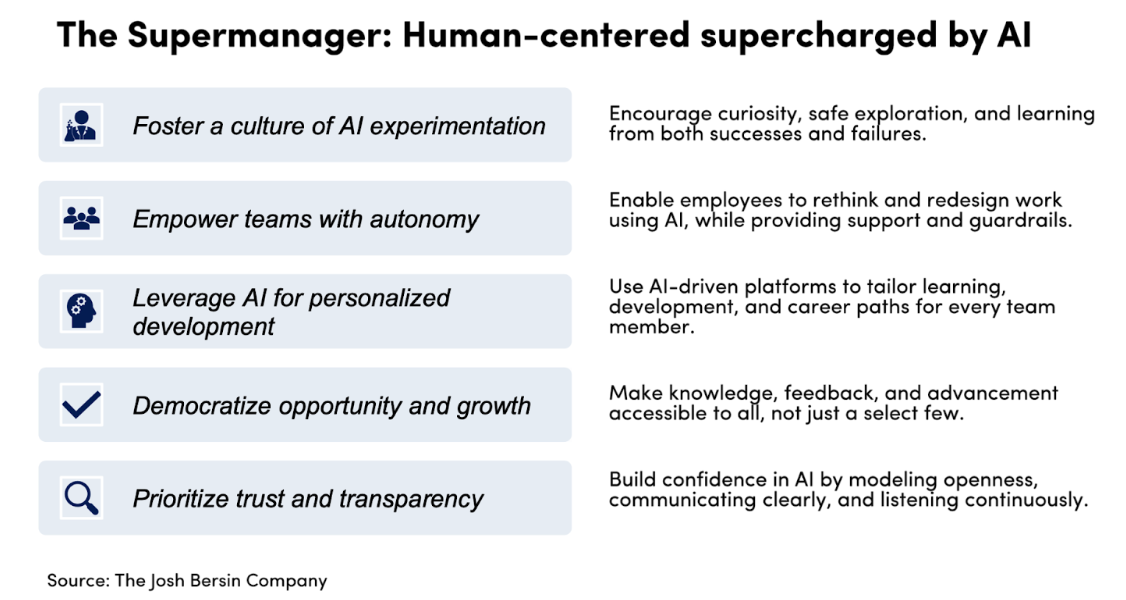
Research from The Josh Bersin Company frames this as the rise of the “supermanager”—a leader who is human-centered but supercharged by AI. The role of manager now includes fostering a culture of AI experimentation, empowering teams with autonomy to redesign work, leveraging technology for personalized development, democratizing opportunity and growth, and prioritizing trust and transparency.

All of this is a huge change from the traditional manager role—and many managers simply aren’t prepared. More than eight out of 10 managers enter management without formal training. These “accidental managers” were promoted based on organizational needs or excellence as individual contributors, not because they were ready to lead. Then, faced with the overwhelming demands of the role, they find themselves treading water with no time to catch up on their development.

Unsupported Managers Become a Bottleneck

When managers struggle, everything downstream suffers. Employee engagement drops. Development stalls. Retention becomes a problem. The very transformation initiatives that organizations are counting on get stuck because the people responsible for driving them through teams don’t have the capacity or capability to make them work.

According to the World Economic Forum’s Future of Jobs Report, by 2030, 59 out of every 100 workers will need training—29 requiring in-role upskilling, 19 needing redeployment to new roles and 11 at risk of displacement. Managers are central to making that development happen. They’re the ones who create space for learning, provide coaching conversations and help people apply new skills in real work.

But only about half of HR teams believe they have the right skills to deliver this kind of impact. If the function that’s supposed to support managers is itself under-resourced, where does that leave managers?

What Managers Actually Need

To help managers meet these expanded expectations, we need to rethink how we support them. Based on current research and what I’m seeing work with our clients, three priorities stand out:

  1. Development that fits into their reality. Managers don’t have time for multi-day workshops or lengthy courses. They need micro-learning they can engage with in short bursts—five minutes between meetings, 30 minutes during a commute. The learning has to be immediately applicable, not theoretical. With our New LensⓇ app, we’ve seen firsthand that this approach significantly increases completion rates and accelerates behavior change.

  2. Multiple types of support. No single intervention is enough. Effective manager development combines individual learning with peer cohorts where managers can share challenges and solutions, plus coaching—whether that’s from their own leader, a professional coach or structured peer coaching. The combination creates reinforcement loops that help new behaviors stick.

  3. A psychologically safe space to practice. Managers are being asked to foster psychological safety for their teams, but they need it, too. In fact, research published in Harvard Business Review found that middle managers feel less psychologically safe than both senior executives and their own team members. Newly promoted managers scored even lower. Managers need spaces to test new approaches, make mistakes and build confidence before deploying new skills in high-stakes situations. This is especially true as they learn to leverage AI tools alongside their teams.

The Business Case for Manager Development

I understand the budget pressures L&D teams are facing. Every investment has to show return. So here's how I think about the business case for investing in managers:

Managers are the multiplier. When you develop an individual contributor, you improve one person's performance. When you develop a manager effectively, you improve the performance, engagement and development of everyone on their team.

The research backs this up. According to LinkedIn’s Workplace Learning Report, 94% of employees would stay at a company longer if it invested in their career development. And managers are the primary source for that development—through the feedback they give, the opportunities they create and the coaching conversations they have.

A participant in our webinar put it this way: “Younger employees are looking to their managers for purpose.” That's not something you can deliver through a learning management system alone. It has to come through equipped, confident managers who know how to have those conversations.

3 Big Questions About Your Manager Development

As you think about your organization’s development programs for managers, consider these questions:

  1. Does your current development approach fit managers’ reality—time constraints, hybrid work, information overload—or does it ask them to carve out time they don't have?

  2. Are you providing managers with multiple types of support (learning, peer connection, coaching), or relying on a single approach?

  3. What percentage of your development budget is specifically focused on managers (not just executives)?

The manager squeeze is real. But it's also addressable—when we design support that meets managers where they are and helps them build the capabilities they need right now.

Ready to Strengthen Your Manager Pipeline?

For over 17 years, Newberry Solutions has helped Fortune 500 companies develop high-performing leaders through coaching, consulting and our award-winning New Lens® leadership development platform. Whether you’re looking for executive coaching for senior leaders, scalable development solutions for managers at all levels or help designing a leadership development strategy that fits your organization's reality, we can help. Contact us to learn more.


Don’t wait for performance to drop before taking action. Discover how the New Lens® platform helps organizations support managers with bite-sized, actionable learning—built for today’s fast-paced, high-stress environments.

Leadership Skills for the AI Era

As the new year begins, we’re all hearing a lot about transformation sweeping the world of leadership development. It’s hard to keep track! For a quick overview of the latest research, check out my recent article. And if you're looking for something solid to hold onto amid all this change, here's what I keep coming back to: The timeless fundamentals of leadership still hold true. In fact, I believe that they’re the key factor that determines whether a company will evolve for the AI era or get left in the dust.

So what are these essential skills and capabilities? And how can you identify the specific areas where individual employees need more development? These questions drove the development of our New Lens® learning platform. The answers we discovered are important for every HR and L&D professional to know.

Why Fundamentals Matter Now

After 25 years of coaching executives and designing leadership solutions for Fortune 500 companies, I've watched what holds up when everything else is shifting: the human skills that allow leaders to navigate complexity, inspire teams, and make sound decisions under pressure. These fundamentals matter even more when we're all tired, when change feels relentless, and when it's hard to remember why we got into this work in the first place. Research shows that technology is advancing faster than job roles and skills can keep up, creating what Bersin calls an “AI productivity and skills gap.” The teams and organizations that close this gap are those where managers facilitate experimentation, orchestrate collaboration between humans and AI, and help people redesign work itself.

These capabilities show up across every coaching engagement, custom solution, and development program we design. These aren’t trendy skills that will be obsolete next year. They’re the essential building blocks—proven to get results across industries and economic conditions. And as AI reshapes the workplace, they become even more critical.

Think of it this way: AI is rapidly changing what work gets done and how it gets done. But leadership—the ability to guide people through uncertainty, build trust, and align efforts toward meaningful goals—is more human than ever.

Essential Skills for Leading Through AI Transformation

Here are the fundamental leadership capabilities that organizations need right now. Each reflects what we’re seeing and learning as we work alongside leaders navigating AI transformation—through coaching, scalable development programs, and custom solutions designed for specific organizational challenges. The Josh Bersin Company calls leaders who master these capabilities “supermanagers”—those who blend human-centered leadership with AI adoption to drive transformation. That's exactly what we're seeing work in practice.

Seeing the Big Picture

How it supports AI transformation: As AI automates tactical work, leaders must elevate their thinking. They need to understand how AI fits into the broader organizational strategy—where it creates value, where it introduces risk, and how to position their teams for the changes ahead. Strategic thinkers can distinguish between AI hype and genuine opportunity, making smarter investment decisions.

Signs of skill gaps: Leaders who focus more on short-term deliverables and less on long-term needs. They react to AI with hesitation or resistance, rather than thoughtful evaluation. Their teams lack clarity about how their work connects to the big picture and priorities.

Focusing on the Right Work 

How it supports AI transformation: One of the first things I do with coaching clients is helping them understand their “Big 3”—the top three things they can uniquely do that have the greatest impact on the business. We build this framework into all our work—coaching engagements, custom leadership development solutions, and scalable programs like New Lens. This understanding helps leaders determine what they can delegate to AI and what tasks need to remain high-touch.

Signs of skill gaps: Leaders who constantly seem to be “putting out fires.” They believe that if they want something done right, they have to do it themselves. They struggle to articulate what work truly requires their unique skills versus what could be handled by others—or by AI.

Communicating with Influence and Impact

How it supports AI transformation: Change requires communication—and AI transformation involves relentless change. Leaders must articulate the “why” behind AI initiatives in ways that resonate emotionally, not just logically. They need to translate technical possibilities into compelling visions that motivate their teams to adapt and learn.

Signs of skill gaps: Teams that seem confused about priorities or resistant to change. Messages that land differently than intended. Leaders who over-rely on email rather than direct two-way conversations. A lack of trust or psychological safety within the team. When I see these patterns, the root cause is almost never that the leader doesn't care—it's that they haven't been taught how to communicate change in a way that lands

Building Visibility and Credibility

How it supports AI transformation: In a world where AI can generate content, analysis, and even code, leaders need to be known for their judgment, their relationships, and their ability to see connections others miss. Building visibility ensures decision-makers recognize the unique value you and your team bring.

Signs of skill gaps: Leaders whose contributions go unrecognized despite strong results. Teams that get passed over for high-profile projects. Difficulty gaining support for new initiatives. An assumption that “good work speaks for itself” without any intentional effort to share wins.

Navigating Organizational Dynamics

How it supports AI transformation: During AI implementation, there will be territorial concerns, budget battles, and competing priorities. Leaders who can skillfully navigate these dynamics—building coalitions, managing stakeholders, and finding win-win solutions—will drive successful adoption while others get mired in resistance.

Signs of skill gaps: Leaders who are blindsided by organizational decisions. Initiatives that stall despite clear business value. A tendency to avoid conflict or dismiss organizational politics as “games.” Difficulty influencing peers or getting buy-in from other departments.

Building a Powerful Network 

How it supports AI transformation: Nobody navigates transformation alone. Leaders with strong networks have access to diverse perspectives, early information about changes, and support when initiatives hit obstacles. As AI reshapes roles and reporting structures, relationships become even more valuable—they’re the connective tissue that makes organizations function.

Signs of skill gaps: Leaders who only network when they need something. Limited relationships outside their immediate team, department, or function. A network of people who look exactly like they do. Difficulty getting meetings with key stakeholders or being left out of important conversations.

Building Leadership Courage and Resilience 

How it supports AI transformation: Transformation is exhausting—and it’s fueling manager burnout. Leaders need the resilience to sustain their energy through waves of change and the courage to make tough calls, advocate for their teams, and speak up when AI initiatives are heading in the wrong direction.

Signs of skill gaps: Leaders showing signs of burnout—cynicism, disengagement, declining performance. Avoiding difficult decisions or conversations. An inability to bounce back from setbacks. Teams that mirror their leader’s stress and anxiety.

Developing a High-Performing Team

How it supports AI transformation: AI amplifies team capability—but only if the team is already functioning well. Leaders who can build trust, foster psychological safety, and create clarity around roles and expectations will see AI multiply their team’s impact. Those with dysfunctional teams will find that AI only magnifies existing problems.

Signs of a skill gap: High turnover and difficulty retaining top talent. Team members working in silos rather than collaborating. Meetings that feel like status updates rather than true collaboration. A lack of constructive conflict—either too much discord or artificial harmony.

Leading with Emotional Intelligence

How it supports AI transformation: As AI handles more analytical tasks, emotional intelligence becomes the defining human capability. Leaders need to read the room, sense when team members are struggling with change, and respond with empathy while still driving results.

Signs of skill gaps: Leaders who are surprised by team reactions to change. Difficulty managing their own stress in ways that don’t affect the team. Feedback that is either too harsh or avoided entirely.

Reimagine L&D in 2026

The way we think about learning and development is shifting—fast. On Thursday, January 29, I’ll be hosting a live session: “What’s Next for L&D: The Biggest Shifts Shaping 2026.”

I want to share what I'm learning and synthesizing from working with organizations in real-time: what's actually shifting, what's working, and how we're all adapting together. We’ll talk about:

  • The biggest drivers of high performance in the current environment

  • How AI is (really) reshaping learning strategy

  • What all of this means for managers and leaders

  • Scalable coaching models that actually work

I'd love to explore these questions together. Join us if you're trying to figure out what's next.

📅 Thursday, January 29, 2026

🕒 12:00 PM CT

🔗 Reserve your spot here: https://luma.com/qkos4s7j


Don’t wait for performance to drop before taking action. Discover how the New Lens® platform helps organizations support managers with bite-sized, actionable learning—built for today’s fast-paced, high-stress environments.

L&D in 2026: 12 Key Facts You Must Know

Some years bring incremental changes in leadership development. Others seem to change the whole game. Based on the signals I’m seeing and the questions I’m getting, 2026 is shaping up to be a year of seismic shifts. So what does your organization need to know to keep pace? Here are some key findings that are shaping how we work with clients and implement our New Lens®  platform. I’m interested to hear whether this list aligns with what you’re observing.

Image by Gordon Johnson from Pixabay

The Leadership Crisis

1.  71% of leaders report significantly higher stress since stepping into their current role. The takeaway: Stress is the defining feature of leadership today. That means leadership development must teach capabilities like staying resilient (and helping others do so), setting priorities and managing personal energy.

2.  40% of stressed leaders are considering leaving leadership roles entirely to protect their wellbeing. The takeaway: I'm struck by how many leaders I’m hearing about who aren’t just leaving their current roles; they're done with leadership altogether. This signals deep problems on the horizon.

3.  Trust in immediate managers has declined 37% since 2022. The takeaway: It's only natural that employees would mistrust unprepared managers, many of whom never wanted the job in the first place.

4.  Only 44% of managers report having received any formal training. The takeaway: This shortfall feeds other problems ranging from retention to morale.

Sources: DDI, Gallup

The Manager-Engagement Domino Effect

5.  Manager engagement dropped from 30% to 27%, driving a broader decline. The takeaway: When managers disengage, their teams follow: 70% of team engagement variance is attributable to the manager.

6.  Global employee engagement fell to 21%—matching the lowest levels since the pandemic lockdowns. The takeaway: Low engagement cost the global economy trillions of dollars in lost productivity.

7.  In recent workplace learning surveys, employees increasingly expect their managers to serve as their primary guide to learning and career opportunities—yet most managers say they haven't been trained to coach or develop others. The takeaway: This gap between expectation and preparation is one of the most urgent disconnects I see in organizations right now. Manager-driven career development support is simultaneously more important and more fragile than ever, making manager coaching skills a non-negotiable focus for L&D.

Sources: Gallup, LinkedIn Workplace Learning

L&D as Competitive Advantage

8.  L&D consistently ranks among the top factors in employment decisions. 83% of employees call development opportunities vital when choosing an employer; 92% say they'd choose the employer with better L&D given two similar offers; and L&D consistently appears alongside work/life balance and career progression as one of the top reasons employees choose an employer. The takeaway: Can we retire the idea that development is a “perk”? High-potential candidates are effectively screening you on your development offerings.

9.  66% of workers say they would consider leaving within 12 months if career-development-focused L&D were reduced or removed. The takeaway: Cutting learning is often a false economy that accelerates attrition.

10.  37% of Gen Z employees say they would look for a new job if their company doesn't provide adequate training opportunities. The takeaway: As Gen Z grows to about a third of the workforce by 2030, organizations that neglect development will face serious retention challenges with their youngest employees.

Sources: Docebo/People Management, TalentLMS, Iventiv, Scheer IMC

The Skills Evolution

11.  39% of workers' core skills are expected to change by 2030. The takeaway: The rapidly evolving business environment makes it more important than ever to focus on timeless capabilities like clear communication and strategic thinking.

12.  Employees increasingly rely on peers and digital learning communities, not just formal programs, to keep up with change. The takeaway: L&D strategies that blend formal curricula with peer learning, mentoring and communities of practice will be best positioned to keep pace with the speed of work.

Sources: World Economic Forum, LinkedIn Workplace Learning

Go Deeper at Our Next Webinar

On January 29, join me for a session focused on 2026’s most important L&D trends. 

We’ll share what we’ve learned through our work with New Lens about why traditional learning methods often fail to deliver sustainable change, what employees across generations expect from their development experience, why coaching remains one of the most underused tools in L&D, and how to create connection and change at scale—even in hybrid or distributed teams.

Join us to explore practical ways to ensure your leadership development efforts drive real results. Here are the details:

📅 Thursday, January 29, 2026

🕒 12:00 PM CT

🔗 Reserve your spot here: https://luma.com/qkos4s7j


Don’t wait for performance to drop before taking action. Discover how the New Lens® platform helps organizations support managers with bite-sized, actionable learning—built for today’s fast-paced, high-stress environments.

What AI Can—and Can’t—Do in Leadership Development

If you’re planning your 2026 leadership development strategy right now, you’re hearing a lot about AI. In fact, it might feel overwhelming. How do you know where to invest—especially when budgets are tight?

Let’s simplify things: AI has real value in leadership development. But it’s not a magic solution. When we implement our New Lens® platform with clients or provide other services (like coaching), we get a firsthand look at what’s actually working—and what’s not—across a variety of industries. So, as you finalize your 2026 L&D plans, let me share some insights on AI in leadership development that I hope will save you time, money and stress as you equip your people to lead through these change-filled times.

Where AI Delivers Value

AI excels at tasks that are data-intensive, repetitive and scale-dependent. In leadership development, that means:

  • Content delivery and logistics. AI can schedule learning modules, send reminders, track completion rates and adapt content sequences based on learner progress. It handles the administrative scaffolding that used to eat up program coordinators’ time.

  • Initial knowledge transfer. For foundational concepts—emotional intelligence, delegation, meeting facilitation—AI can deliver consistent, accessible content to hundreds or thousands of learners simultaneously.

  • Data analysis and reporting. AI can quickly identify patterns across cohorts, flag engagement issues and surface which modules resonate most with different learner groups. This helps you refine programs faster than manual analysis ever could.

The Critical Leadership Skills AI Can't Teach

But here’s where I’m worried many organizations will make expensive mistakes in their 2026 planning. On its own, AI cannot develop the most critical leadership capacities your organization needs.

One big shortcoming of AI is that contextual judgment requires lived experience. AI struggles with ambiguity. It can process enormous amounts of data, but it interprets that data rigidly. Leadership decisions, on the other hand, depend heavily on context: organizational culture, team dynamics, individual circumstances and ethical considerations that aren’t easily codified into algorithms.

When your leaders need to decide how hard to push the team, whether to escalate an issue or not, whether to follow established processes or make an exception—that requires the kind of contextual wisdom that comes from actual human experience, not data analysis.

Making Smart Investment Decisions for 2026

What does this mean for your 2026 planning? Here’s how to think about it:

  • Your 2026 leadership strategy should not start with decisions about technology. Instead, first determine the leadership capabilities your organization actually needs (for most companies, those capabilities include strategic thinking, emotional intelligence, change leadership and team building). Then determine which tools best support that development—whether they use AI or not.

  • Complement that learning with human connection and real practice opportunities. For example, an AI platform might deliver foundational content on how to delegate. But then leaders join peer cohorts where they discuss the real delegation challenges they’re facing, practice difficult conversations and hold each other accountable for applying what they’re learning. The AI handles the “what”; humans handle the “how” and the “why.”

  • Plan for continuous learning, not one-time training events. The business landscape keeps changing. Leaders need ongoing development, not annual workshops. AI can support continuous micro-learning that leaders can access when they need it.

This is exactly the approach we’ve taken with New Lens. Our platform uses technology to deliver customized development plans and make learning accessible anytime, anywhere—but the real transformation happens through peer cohorts, practical application and connection with others facing similar challenges.

Looking Ahead

AI will continue advancing. But the fundamentals of leadership development won’t change: Your people will still develop leadership capacity through challenge, reflection, practice, feedback and connection with others who are also growing.

Your 2026 strategy should use AI where it genuinely adds value—efficiency, scale, accessibility, data analysis. But don’t forget the human elements: meaningful practice, honest feedback, peer learning and the kind of authentic connection that builds trust.

If you would like to talk in more depth about determining the capabilities your leaders need most or how your leadership development programs should take shape in 2026, just drop us a note. We have the deep experience to identify your organization’s challenges, plus a full toolbox of solutions—New Lens, executive coaching and more.


Don’t wait for performance to drop before taking action. Discover how the New Lens® platform helps organizations support managers with bite-sized, actionable learning—built for today’s fast-paced, high-stress environments.
Old Playbook, New Game: Agile Leadership Development

Remember this time last year when your organization was planning for 2025? How did you predict the year would unfold? What challenges did you anticipate for your leaders? And how did your predictions compare to the reality of what actually happened?

Image by StartupStockPhotos from Pixabay

The disconnect between how fast business moves and how slowly most leadership programs adapt has become a pressing problem for L&D leaders. DDI has found that less than one-quarter of HR organizations emphasize future-focused skills like setting strategy and managing change. It’s challenging to think about what leadership development should look like for your organization in the coming year when the only thing we can say for certain about 2026 is that rapid transformation will continue.

As we were developing our New Lens® learning platform, we quickly realized traditional leadership development didn’t fit today's business environment and that we needed to create something different. Since then, we’ve seen New Lens deliver real results for our clients, even in times of intense disruption.

If unanticipated changes made your 2025 programs feel outdated by midyear, it’s time to shift your thinking for 2026. You can deliver leadership development that adapts to the twists and turns. And here’s how it can take shape.

The Hidden Cost of ‘Content Dump’ Programs

Most traditional leadership programs operate on a “content dump” model. The assumption is that leaders need to be filled up with knowledge in advance. Attend the three-day offsite. Absorb the frameworks. Complete the case studies. Return to work fully equipped.

This approach assumes you can predict what leaders will need to know months from now. It assumes your business strategy will remain relatively stable, and that the leadership challenges your participants face in Month 1 will still be relevant in Month 12.

But in today's business environment, these are dangerous assumptions.

Think about what your leaders are actually navigating: Hybrid work arrangements require entirely new management approaches. AI tools are transforming how work gets done faster than anyone can keep up with. Leaders must make rapid decisions while trying to keep everyone engaged through constant change.

Your leadership program was designed for a different game than the one being played.

Enter the Agile Alternative

But what if your leadership program could adapt as quickly as your business does? What if instead of frontloading content, you could help leaders build skills progressively while applying them in real time?

This is where agile methodology transforms leadership development. Agile means iterative, responsive, and built for constant change. Instead of dumping content all at once, you help leaders quickly absorb concepts, apply them, experiment, and refine their approach—all while ideas build on each other in a structured progression.

Josh Bersin, one of the world's leading HR analysts, has been championing this shift for years. In his research on building agile organizations, Bersin emphasizes that agile organizations “evolve their strategy but deepen it where they have strength.” Management is “thin, hands-on, and highly engaged. And people and teams are constantly learning.”

The key word there is “constantly.” Not annually. Not quarterly. Constantly.

More recently, Bersin's research on why leadership development feels broken points to the core issue: When companies redefine their business models every few years, creating new organizational structures and designing solutions around data and customer experience, traditional “long-form” leadership development simply doesn't keep up.

Learn-Apply-Experiment

The “content dump” model breaks down when the challenges leaders face tomorrow look nothing like the ones you prepared them for yesterday.

Agile development recognizes that modern leaders need ongoing support navigating constant change. They don’t need three days of content downloaded at once. They need the right insight at the right moment. They need connection with peers facing similar challenges. They need space to try something, reflect on what happened, and adjust their approach.

This is the learn-apply-experiment approach. Ideas still build on each other in a logical sequence, but the emphasis shifts from passive absorption to active application. Leaders learn by doing, supported by:

  • Micro-learning that fits into the flow of work. Not all-day workshops that pull people away from their teams, but two- to seven-minute lessons they can access on their phones between meetings. Research shows employees have an average of just 24 minutes per week for dedicated learning, typically interrupted every three minutes. Leadership development has to meet people where they are.

  • Peer cohorts for real-time problem-solving and accountability. When priorities shift mid-quarter, leaders don’t have to wait until the next module to discuss how to respond. They’re already in regular conversation with peers navigating similar challenges.

  • Immediate relevance. Let’s be real: The idea of learning something they aren’t sure they will ever use is not very motivating for your leaders. With the learn-apply-experiment approach, leaders can learn something today, put it into action this week and then reflect on what happened with others during their cohort’s meeting.

Agile Leadership Development in Practice

So what does agile leadership development actually look like when you implement it? We designed New Lens around features like these:

  • Content stays nimble. You maintain core leadership principles—the foundational strategies that consistently drive results—while keeping application examples flexible. When your organization announces a major restructuring, you don’t need to redesign the entire program. You adjust the real-world scenarios and discussion questions your leaders are working through.

  • Implementation adapts to organizational reality. Programs can launch with cohorts who progress together, or operate on an open-enrollment basis where individuals start when they need it. Content gets selected to fit specific organizational needs before the program begins, but can be adjusted as those needs evolve.

  • Learning integrates with real work constraints. Just five minutes a day or 30 minutes a week. Accessible on mobile devices, wherever leaders are working. Built around how work actually happens rather than requiring people to stop working in order to learn.

  • Feedback loops operate continuously. Regular cohort check-ins where leaders discuss real challenges they’re facing. Manager involvement through progress dashboards and discussion guides. Action plans that leaders customize for their actual situations and can update as circumstances change.

This approach addresses what Bersin identifies as the critical need for “learning in the flow of work”—providing employees with the information they need, when they need it, without interrupting their work processes.

What Will Your Leaders Need in 2026?

How will your leadership development programs respond to the change and disruption in 2026? Remember, we're here to help. If you'd like to talk more about New Lens or our other products and services, like executive coaching, just drop me a note.


Don’t wait for performance to drop before taking action. Discover how the New Lens® platform helps organizations support managers with bite-sized, actionable learning—built for today’s fast-paced, high-stress environments.

What Is Change Fatigue and How Can You Address It?

Your leadership team just rolled out the third major initiative this quarter. Your managers are implementing AI tools while navigating return-to-office policies and budget constraints. You’re constantly hearing about change agility and staying competitive. But there’s also an important truth that no one is saying out loud: Your people are exhausted.

This is something all organizations need to be talking about. More than half of HR leaders say employees at their organization are suffering from change fatigue. In another survey, almost three-quarters of respondents said their organizations were maxed out on change, or close to it. 

It’s easy to see why. In just the past five years, we’ve been through a pandemic, seismic political and social changes, the rise of AI and the shift to hybrid work. This level of transformation is not something employees can just shake off and power through. And there’s no end in sight.

When companies contact us about our New Lens® learning platform, building capability in the midst of change fatigue is often one of their biggest concerns. With that in mind, let’s take a closer look at change fatigue and how you can help your employees weather it.

What Does Change Fatigue Look Like?

The Center for Creative Leadership sums it up well: Change fatigue is “a state of exhaustion that occurs when individuals or organizations experience continuous, rapid, or overwhelming changes.”

Change fatigue hits leaders and managers especially hard. After all, they’re not only managing change themselves; they’re also helping their employees through all the disruption. Managers often deliver challenging news about things like layoffs, budget cuts and reorganizations.  They also communicate with their teams about what comes next and what things will be like going forward—all while dealing with their own stress and anxiety.

Reduced drive, motivation and engagement are all signs of change fatigue. You may also notice that employees who used to be advocates of change are now resisting it. Don’t ignore these signals: Left unaddressed, change fatigue can lead to burnout and even physical illness.

Why Is Change Fatigue So Extreme Right Now?

We all have “surge capacity”—mental and physical systems we draw on to get through short-term stress. The problem, though, is that long-term changes keep piling up:

  • At larger companies, leaders manage an average of nine major change initiatives per year. And many of them are ready to throw in the towel: Almost 40% said they would consider walking away rather than lead through another big change.

  • New technologies are emerging at an unprecedented rate, making existing systems and strategies obsolete almost overnight. This constant cycle of innovation creates a perpetual sense of urgency for organizations to keep pace with the latest trends and advancements, leaving little time to reflect and recharge.

  • More than 70% of organizations are dealing with too many changes at once. This overload leads to confusion about where to focus on and makes it harder to implement those changes effectively.

We just don’t have the reserve capacity to carry us through years of ongoing, intense transformation. So there’s a good reason that we all feel like we’re running on empty—we are!

Equip Your People to Handle Change

Change isn’t going to stop. So how can you help your people “refill their tanks”?

  • Anchor on purpose. Korn Ferry identifies “anchoring on purpose” as one of the key principles for building change-ready organizations. Give every employee a clear line of sight into how their work contributes to meaningful goals. When employees understand the “why” behind change, they’re more likely to stay engaged. Learning and growth also contribute to a sense of purpose.

  • Build organizational resilience, not just individual resilience. When organizations actively work to build resilience—connecting individual work to organizational goals, fostering psychological safety, and providing coaching through transitions—they create cultures that can adapt without breaking.

  • Make development more accessible. Traditional approaches to leadership development have focused on a select few high performers. But technology now makes it possible to expand development opportunities so that more of your people can become effective change leaders.

  • Make learning part of every day. Continuous change requires continuous learning, not just one-time trainings. Your people need ways to learn in the flow of work with content that supports strategic outcomes.

  • Clearly communicate. Leaders have to be skilled and emotionally intelligent communicators to enroll others in change. A lack of communication about why a change is happening and what its effects will be leaves people feeling overwhelmed and disengaged.

  • Simplify and prioritize. When handling multiple changes, prioritize the most important changes first, connect the dots to show how different changes work together and pace changes so the organization isn’t trying to do everything at once

  • Build connection into development. Successful transformation requires people who are engaged, motivated and willing to go above and beyond. If your people are feeling checked out, building connections between employees can help. For example, mentoring, coaching and cohort learning can help people connect across levels and departments.

  • Provide genuine support. Amid constant change, employees can feel overwhelmed or unsure of how to perform their roles, which in turn can affect confidence and morale. To address these feelings, foster a culture that celebrates successes, encourages open communication and provides opportunities to take breaks and recharge to avoid burnout.

The Platform That Builds Change-Ready Leaders

As you think about your priorities for 2026, I encourage you to put transformation fatigue on the agenda as a strategic imperative.

New Lens is built for this era of nonstop change. It focuses on the Core Strategies that build essential leadership capabilities like emotional intelligence, resilience, and strong communication. It’s also designed to be scalable, so you can give more employees the tools to manage continuous transformation without burning out. To see New Lens in action, request a demo. And if you have other questions about developing change-ready leaders, just drop me a note.


Don’t wait for performance to drop before taking action. Discover how the New Lens® platform helps organizations support managers with bite-sized, actionable learning—built for today’s fast-paced, high-stress environments.

Gen Z Isn’t the Real Problem—a Lack of Development Is

Did you know there are now more members of Gen Z than Baby Boomers in the workforce? For many, though, their careers are not exactly starting out smoothly. According to recent research, only 2% of Generation Z job seekers align with what hiring managers want most—achievement orientation, drive for professional success, and a strong work ethic. Meanwhile, a survey by Intelligent.com found that 75% of companies deemed some or all of their recent graduate hires unsatisfactory, with one in six employers now reluctant to hire Gen Z workers at all.

But here’s what no one’s asking:

What if the problem isn’t Gen Z after all?

What if it’s the way we approach developing younger employees?

Why Are Companies Firing Gen Z Employees?

According to the Intelligent.com survey of nearly 1,000 hiring managers, the top reasons for dissatisfaction with Gen Z hires include:

  • Lack of motivation or initiative (cited by 50% of leaders)

  • Poor communication skills

  • Being unprofessional or unorganized

  • Inability to handle feedback

  • Struggling to manage workload

  • Not understanding workplace norms (from dress code to professional behavior)

You might have your own anecdotal “evidence” about how your younger colleagues are failing to adapt to the workplace. Perhaps you’ve seen the now-viral “Gen Z stare”—a blank, expressionless gaze that older colleagues interpret as disengagement. Or maybe everyone on your team is still talking about the Gen Z job candidate who brought a parent to their interview.

These stories make for great LinkedIn debate fodder. But they mask a more fundamental truth.

The Real Gen Z Workplace Problem

As with all generations, the truth about Gen Z is more nuanced than these emerging stereotypes. While it’s important to understand the values of these young employees, we also have to look at how we’re preparing them for the workplace.

Consider these statistics:

Why is this happening? We still tend to assume that young employees will pick up workplace norms, communication styles and leadership skills simply from being around their colleagues every day. Gen Z, however, was shaped by remote learning during the pandemic and entering a largely hybrid workplace. They just haven’t had the same opportunities older generations did for learning by osmosis. In other words, you probably learned the “rules” of your organization by being immersed in your office culture. That system of implicit teaching is much weaker now. But we’re still blaming Gen Z for not automatically intuiting what their employers and colleagues expect.

How to Help Gen Z Employees Succeed

If you’re feeling frustrated with Gen Z employees who seemed so promising when you hired them, helping them turn things around might feel overwhelming at first. But let me reassure you that you don’t have to “reinvent the wheel.”

Through coaching Fortune 500 executives and creating the New Lens ® learning platform, my company has identified the Core Strategies that reliably drive success:

1.  Communicate with influence and impact.

2.  Build visibility and credibility.

3.  Focus on the right work.

4.  Navigate politics and organizational dynamics.

5.  Build leadership courage and resilience.

6.  Strategically stand out.

7.  Build a powerful network.

8.  Develop a high-performing team.

The good news is these Core Strategies are consistent across generations and through the constant changes in today’s business environment. I recommend centering them in both your onboarding and continuing development programs.

Next, let’s take a closer look at how developing each of the Core Strategies can help Gen Zers thrive and bring their full potential to their roles.

1. Communicate with Influence and Impact

This isn't about stifling Gen Z's authentic communication style. It's about giving them the tools to be authentic and effective.

What to teach:

2. Build Visibility and Credibility

A key lesson for younger employees is that success doesn’t just depend on what they know. It’s also about how they show up with others.

What to teach:

3. Focus on the Right Work

If seasoned leaders are drowning, imagine being 23 years old and trying to figure out what matters most!

What to teach:

4. Navigate Politics and Organizational Dynamics

Some Gen Zers worry that becoming savvy about office politics is fake or manipulative. But navigating workplace relationships is how work actually gets done.

What to teach:

5. Build Leadership Courage and Resilience

Gen Z’s focus on self-care and wellbeing is an asset when it comes to maintain consistent high performance.

What to teach:

6. Strategically stand out

Gen Zers are already comfortable with self-promotion. Their challenge for them now is learning what works in a professional context.

What to teach:

7. Build a Powerful Network

Members of Gen Z love in-person contact. But they’re not fans of networking events or small talk, and more than half have trouble making new connections.

What to teach:

8. Develop a High-Performing Team

Yes, Gen Z employees need leadership development, too—especially in flatter organizations.

What to teach:

Why Getting This Right Is Crucial

Dissatisfaction with Gen Z employees is more than a hiring problem. It’s a red flag about your leadership pipeline. In just a few years, your Gen Z hires will start becoming managers (if they haven’t already). In a decade, they'll be your senior leaders. We can’t afford to write them off.

Instead, it’s time to get deliberate about transforming leadership development for Gen Z. We know the capabilities they need. The next step is building learning into their jobs from Day 1, instead of assuming it will “just happen.”

New Lens is built around the Core Strategies we talked about above. It’s also designed to be scalable, so you can expand development access to more Gen Z employees at the start of their careers. To see New Lens in action, just request a demo. And if you have other questions about tapping into the potential of Gen Z employees, drop me a note.


Don’t wait for performance to drop before taking action. Discover how the New Lens® platform helps organizations support managers with bite-sized, actionable learning—built for today’s fast-paced, high-stress environments.

Why Cutting Leadership Development Costs More Than Keeping It

Can you believe we’re in the last quarter of 2025? I’m hearing a lot from organizations that are mapping out spending for next year and figuring out how leadership development fits into their budgets. Amid today’s economic uncertainty, areas that are seen as discretionary—like learning and development—can seem like an easy target for cuts.

Again and again, though, I’ve watched companies discover that these “savings” are ultimately erased, as unprepared leaders create costly problems over time. Here’s the bottom line: The cost of NOT investing in leadership development dramatically exceeds the investment itself. If you’re an HR or L&D professional, I know you know this. But I also know that it can be challenging to convince budget decision-makers. So I want to help. In this article, I’ve compiled some of the most powerful evidence that leadership development delivers an impressive ROI, all supported by my firsthand observations as a longtime coach and the creator of the New Lens® learning platform.

The Hidden Cost of Unprepared Managers

Low employee engagement can be a strong sign of inadequate leadership development. Before I explain why, let’s consider the scale of the problem: The cost of employee disengagement in the U.S. alone is approximately $2 trillion in lost productivity annually. Two trillion dollars of wasted potential, every single year.

When disengaged employees leave, the financial hit becomes even more tangible. The cost of replacing an employee ranges from about 200% of annual salary for leaders and managers, to 80% for technical professionals, to 40% for frontline workers. And these figures only capture the direct costs. The broader impact includes disrupted team dynamics, lost institutional knowledge, decreased morale among remaining employees and reduced productivity during transitions.

What does employee engagement have to do with leadership development? Managers account for 70% of the variance in team engagement. In other words, your managers are the single most influential factor in whether your employees are engaged, productive and committed—or disengaged, underperforming and actively job hunting.

Managers Are Struggling

But these all-important employees are also having their own engagement struggles—another sign that they haven’t been adequately prepared for the growing challenges of leading others in today’s intense business environment.

Manager engagement has declined sharply, falling from 30% in 2023 to 27% in 2024. The drops have been particularly steep among younger managers (under 35) and female managers, who are shouldering unprecedented pressure. When managers are disengaged, the effect cascades throughout their teams. According to Gallup, 52% of employees who voluntarily left their jobs said their manager or organization could have done something to prevent their departure. Even more revealing: About 42% of all turnover is viewed by employees as preventable—meaning they believe the organization or manager could have taken action to retain them.

Yet despite the critical role managers play, only 44% report having received any formal management training. Untrained “accidental managers” land in their roles based solely on organizational need, not their own readiness or enthusiasm for leadership.

The Business Case for Leadership Investment

Does leadership development really move the needle on critical issues like productivity, engagement and retention? The findings on ROI are remarkably consistent across studies, and they paint a compelling picture:

  • Companies that provide targeted training to their employees see a 17% jump in productivity and a 21% increase in profitability. An Accenture study found that for every dollar invested in training, companies received $4.53 in return—a 353% ROI.

  • Organizations with well-rounded training programs generate 218% higher income per employee and can boast a 24% higher profit margin than those without formalized training initiatives. These aren't marginal improvements—they're transformational differences in organizational performance.

  • When employees are highly engaged—largely driven by quality management—turnover drops by 51%, well-being improves by 68%, and productivity increases by 23%. Organizations with strong onboarding processes improve new hire retention by 82%, and effective training can reduce employee turnover by 30% to 50%.

  • 70% of employees would consider leaving their current job for a company that invests more heavily in employee development.

  • Well-structured programs deliver measurable results: a 25% increase in learning outcomes, a 20% improvement in job performance, and a 28% boost in effective leadership behaviors.

Learn More About Leadership Development ROI

Of course, simply having a leadership development program does not guarantee these results. Organizations globally invest $60 billion annually in these programs, yet many underperform or fail entirely because of poor design, delivery and evaluation. Choosing a program with a solid ROI can feel overwhelming, but we have a wealth of resources to help you find the right fit for your organization. 

As a starting point, check out our webinars which include powerful trends and practical ideas from our experience and executives at leading companies, especially “The 3C’s of Driving Employee Growth & Retention” and “3 Hurdles When Implementing a Leadership Development Program & How to Avoid Them.” (And don’t forget to sign up for future webinars!) 

As always, please do get in touch if we can help. We’ve been at this for 17 years! From New Lens to executive coaching, our offerings are proven, practical and tailored to your needs.


Don’t wait for performance to drop before taking action. Discover how the New Lens® platform helps organizations support managers with bite-sized, actionable learning—built for today’s fast-paced, high-stress environments.

4 generations, 1 learning solution?

I’m sure you’ve ready plenty of advice on how to manage people who vary widely in age. But there’s another aspect of the multigenerational workforce we don’t talk about enough: ensuring that your organization has leadership development programs that work for all employees. That might feel like a tall order if some of your employees grew up with Woodstock and others with TikTok. So I want to encourage you: Through my work with Fortune 500 companies, I’ve consistently found that combining a few key building blocks can ensure that your employees are building the capabilities they need to thrive even in these disruptive times.

There’s No Age Limit on Development

According to the Department of Labor, Millennials (born 1981-1996) make up the largest share of today’s workforce (36%). Generation Xers (1965-1980) represent 31% of workers; Gen Z (1997-2012) is 18%; and Baby Boomers (1946-1964) are 15%. The Silent Generation (1928-1945) accounts for 1%. 

Younger generations often claim the spotlight when it comes to learning and development. That’s only natural as companies try to strengthen weak leadership pipelines and bring unprepared new graduates up to speed. Older generations still want to learn and grow at work —  but feel they have fewer opportunities to do so.

I’m passionate about the fact that learning is essential for all generations: It’s crucial for retention, engagement and even well-being. So how can you make sure employees of different ages have options that align with their needs and preferences?

Mentorship Builds Connections

Mentorship and reverse mentorship have far-reaching benefits across generations. Millennial and Gen Z employees don’t just gain knowledge from mentors; they also build relationships that are equally crucial for their future success. As younger generations report difficulties forming relationships due to hybrid work, mentorships take on added importance.

For older employees, mentoring contributes to a sense of purpose at work. Passing along their years of acquired knowledge can be deeply meaningful. They also have a lot to learn from their younger peers — from tech skills to work-life balance. 

Formal programs can help employees find mentors more effectively. More than eight out of 10 of Gen Z employees believe mentorship is crucial, yet only half report successfully securing a mentor. Organizations need structured approaches that make these connections accessible and sustainable.

This connection gap was top of mind when my company created our New Lens® platform. The content can drive rich, meaningful conversations about topics that drive high performance and accelerate progression. We built in features to facilitate peer learning and create opportunities for employees to learn from each other's experiences.

Going with the Flow

Another leadership approach that I’ve seen employees of all ages respond well to is growth in the flow of work. Microlearning — “snackable” content that employees can access anywhere —  is one way to deliver relevant information right when employees need it. But you can also use low-tech methods like holding post-project reviews, sharing learnings at meetings and providing in-the-moment feedback.

Why is growth in the flow of work so effective? Research has shown that we all retain more when we can put what we’ve learned immediately into practice. We know this intuitively but often underestimate its importance because most of us are also short on time, with an average of 24 minutes to spend learning during a typical work week. Growth in the flow of work fits into busy schedules more easily than a conference or offsite.

Different Generations, Different Preferences

While employees of all ages value connection and relevant, in-the-moment learning, other preferences vary across generations. In implementing New Lens®, my company has seen younger generations, who grew up online, instantly take to microlearning. But you may not realize that this approach also appeals to the sensibilities of Gen Xers, who want autonomy and flexibility in learning.

Baby Boomers, on the other hand, like more structured approaches like classroom training. To stoke enthusiasm among younger employees for in-person sessions, ensure that they include participant interaction, and then highlight the opportunity to build the relationships that Gen Zers and Millennials often struggle to develop.

Meet Diverse Needs with a Unified Strategy

Implementing a truly multigenerational approach to learning and development requires careful planning. Start by assessing your offerings for unconscious generational bias. Are your programs inadvertently designed primarily for one generation's preferences?

All employees need and deserve opportunities to grow and learn—whether they're just starting their careers or approaching retirement. By combining mentorship programs, flexible learning formats and growth in the flow of work, you can create development experiences that resonate with everyone. This approach doesn't just accommodate generational differences—it celebrates the diverse perspectives that make your organization stronger.

Ready to explore how New Lens® can help develop leaders at your organization? Learn more about our platform or contact us to start a conversation about your leadership development needs.


Don’t wait for performance to drop before taking action. Discover how the New Lens® platform helps organizations support managers with bite-sized, actionable learning—built for today’s fast-paced, high-stress environments.

Why Content, Coaching and Connection Drive Employee Retention

It’s a glaring truth: Traditional training programs aren’t delivering the results organizations desperately need and haven’t for quite some time. With employee engagement stagnating and retention challenges mounting, organizations must find more effective approaches to development (and in a way that sticks).

I’m excited about the framework my company has been using to address these challenges. After almost two decades of developing high-performing leaders for Fortune 500 companies and creating the award-winning New Lens® leadership development platform, I’ve identified the three C’s of development that drive engagement and retention as employees learn: content, coaching and connection (and it’s nice to know that Harvard Publishing now agrees with us, too). This development framework has shaped New Lens’ approach to accelerating customized development at scale. So let’s take a closer look at how it works.

Content That Actually Changes Behavior

The first C—content—addresses a fundamental shift in how employees consume learning. Traditional training models built for less chaotic times fail to account for today’s reality: People have approximately 24 minutes per week for development, and those 24 minutes are typically interrupted at least three times. I can definitely relate based on what I’m seeing.

More than nine out of ten people prefer microlearning and snackable content. But effective content has other key qualities as well. It must focus on developing the right skills for a rapidly evolving workplace, be tailored to unique needs and result in actionable insights. In other words, it has to be relevant.

The key is to move away from generic content toward personalized, agile learning experiences. Rick Gomez, Vice President of Human Resources at AT&T, reinforced this during our recent New Lens webinar. “We've got to think about ways to integrate learning into their (employees’) daily tasks, into their daily routine,” he explained.

This approach recognizes that upskilling and reskilling represent ongoing necessities. The most effective organizations integrate development into the flow of work rather than treating it as a separate activity.

Coaching That Multiplies Impact

The second C—coaching—represents perhaps the most dramatic opportunity for improvement. Research from the International Coach Federation and Human Capital Institute shows that coaching can boost productivity up to 88% from just 22% when it follows traditional training.

Yet many organizations struggle to implement coaching at scale affordably and their understanding of what coaching is varies widely. As we have coached leaders, I’ve seen firsthand how coaching dramatically boosts self-awareness and helps leaders understand how their actions impact others. Beyond using external coaches, there are many other ways to embed coaching into organizational culture. 

“Some of the best coaching that I got has actually been from people that have worked for me, or below me, or not even on my team,” Rick shared during the webinar.

Powerful formats like peer coaching demonstrate that meaningful development can happen through structured peer interactions alongside formal coaching relationships or coaching from a manager.

The latest data also shows that coaching also builds ethical leadership by strengthening transparency, accountability and purpose-driven decision-making. In an era where trust in leadership faces increasing scrutiny, ethical leadership is key to building followership and  sustainable organizational success.

Connection in a Fragmented World

The third C—connection—has become more complex as organizational boundaries blur. Hybrid work models, distributed teams and varying physical location requirements create unprecedented challenges to building meaningful professional relationships. 

Leadership capabilities focused on connection particularly matter now—specifically the ability to inspire people, influence others, demonstrate adaptability and create environments where learning flourishes. These skills become critical as traditional mentorship and apprenticeship models adapt to new working arrangements. “In-person connection does drive collaboration, and it does drive innovation,” Rick said.

However, connection extends beyond physical proximity. The most effective leaders create psychological safety and foster collaboration regardless of location. This requires intentional effort to build networks, share vulnerabilities and create forums for organic relationship building.

“The power of networking, the power of having these connections, I think is so important,” Rick emphasized. “Especially for new people that are joining companies, and they’re needing to start right out of the gate building those working relationships and those connections.”

Making the Three C’s Work Together

The magic happens when content, coaching and connection work in tandem. Well-designed programs link all three elements to tangible business outcomes, creating development experiences that drive both individual growth and organizational performance.

Through our New Lens platform and work with organizations across industries, I've seen how the integration of these three elements creates sustainable change. Our content offers valuable strategies to navigate change, build resilience, and strong relationships. The coaching—whether from managers, peers or the platform itself—helps leaders consistently show up in optimal ways. And last but not least, the connection builds the trust and psychological safety essential for success well beyond the program.

Ready to explore how New Lens® can help develop leaders at your organization? Learn more about our platform or contact us to start a conversation about your leadership development needs.


Don’t wait for performance to drop before taking action. Discover how the New Lens® platform helps organizations support managers with bite-sized, actionable learning—built for today’s fast-paced, high-stress environments.

Emotional Intelligence Is More Essential Than Ever in Today's Workplace

Everywhere I turn, leaders are talking about how AI and rapid transformation are reshaping their organizations. The speed of change is staggering. Yet through all this disruption, one truth is clearer than ever: Emotional intelligence isn’t becoming less relevant—it’s becoming indispensable.

In my work with Fortune 500 leaders and through our New Lens® platform, I’ve seen firsthand how our content and design dramatically increase self-awareness and help leaders understand the impact of their actions on others. The platform offers strategies to navigate change and build resilience so leaders can consistently show up in an optimal way—exactly what's needed in today’s challenging environment.

Why Emotional Intelligence Matters More in 2025

Thirty years ago, Daniel Goleman introduced the framework of emotional intelligence (self-awareness, self-regulation, motivation, empathy and social skills). Those principles remain the foundation. What's changed is the context in which leaders must apply them.

Hybrid work makes reading body language a matter of interpreting someone’s engagement through a screen. Decision-making happens at unprecedented speed, with incomplete information. Teams are coping with relentless change, fatigue and uncertainty. Leaders can’t rely on old playbooks; they need the capacity to stay grounded themselves while supporting others through ambiguity.

The leaders who thrive today aren't the ones with all the answers. They’re the ones who use emotional intelligence to spark collaboration, integrate diverse perspectives and create psychological safety when everything else feels unstable.

The Hidden Cost of Leading Through Change

But here’s the challenge: Even the most capable leaders are stretched thin. Change fatigue wears down energy levels and erodes emotional intelligence. When you’re exhausted, you’re more likely to miss cues, snap in conversations or slip into command-and-control behaviors that undermine trust.

This is why being intentional about developing emotional intelligence matters. It’s the anchor that helps leaders show up with steadiness when the ground beneath them keeps shifting.

Help Your Team Build Emotional Intelligence

Building emotional intelligence across your organization doesn't require extensive resources or time away from critical work. You can create meaningful development through strategic approaches that fit into existing workflows:

  • Implement regular team check-ins that focus on workload and well-being.

  • Provide managers with tools for giving growth-focused feedback in real time.

  • Create structured reflection opportunities that help leaders understand their impact on team performance.

  • Invest in scalable solutions that make emotional intelligence development accessible to all levels.

Moving Forward with Confidence

If you're feeling stretched thin, you're not alone. But by investing in your emotional intelligence, even in small ways, you’ll navigate today's changes with more confidence and build the foundation for whatever comes next.

Ready to explore how New Lens® can help develop leaders at your organization? Learn more about our platform or contact us to start a conversation about your leadership development needs.


Don’t wait for performance to drop before taking action. Discover how the New Lens® platform helps organizations support managers with bite-sized, actionable learning—built for today’s fast-paced, high-stress environments.

How to Develop Leaders for the AI Age

Recently, MIT Sloan Management Review published one of the most important articles I’ve read on AI and leadership. In “Why AI Demands a New Breed of Leaders,” authors Faisal Hoque, Thomas H. Davenport and Erik Nelson propose that while most organizations think of AI implementation as a technical challenge, they also need leaders who can manage the “profound cultural and organizational changes” that AI brings.

They make a compelling case—one that should spark conversations for executives, HR and L&D professionals, and all of us who develop leaders. As creator of a learning platform and a longtime coach for Fortune 50 companies, I’ve identified some key priorities for organizations to keep in mind as they cultivate leaders who can bridge technical expertise and change management.

Raise Your ‘Unicorns’ In-House

The MIT article envisions a role that might be called the “chief innovation and transformation officer.” A “CITO” would combine technical knowledge with strategic vision and deep understanding of organizational psychology and culture.

That’s a rare combination of skills. But before you craft a job posting seeking a “unicorn,” I recommend a different strategy: Develop these capacities in-house. Start by identifying potential leaders who excel at big-picture thinking. Who is able to “connect the dots” between technology initiatives and broader organizational goals? They could become your most valuable asset in these times of transformational change, so it pays to invest in their learning and growth.

Break Down Silos

The most challenging part of AI transformation isn’t usually the technology itself. It’s creating an adaptable, resilient culture where innovation can flourish. More than nine out of 10 large-company data leaders feel this way, according to the MIT article.

AI is a big, complex challenge. No single leader, or single department, is going to have all the answers. In these situations, I’ve seen the power of bringing together cross-functional leadership teams who represent a variety of perspectives.

Consider building this approach into your leadership development programs. Cohorts of emerging leaders from different departments could come together both for learning and to talk about your organization’s AI goals. This kind of collaboration increases understanding and buy-in, and it helps head off resistance to change.

Big Results from Micro-learning

As we all know by now, the AI landscape changes fast. That means development for AI leaders has to be ongoing. Traditional once-a-year training programs won't cut it.

Amid rapid disruption and transformation, our clients are embracing “growth in the flow of work”: integrating learning directly into daily work processes rather than separate training events. They like the fact that their leaders can access relevant guidance anytime through micro-learning — “bite-size” lessons two to seven minutes long.

There’s a growing body of evidence about how this approach drives business results. Research from Josh Bersin, for example, shows that organizations that embed learning into everyday work are 37% more likely to be first to market with innovative products and services.

Lift Up Different Voices

I was fascinated to read in the MIT article that Zillow and Air Canada experienced significant failures in their AI implementations because leaders didn't think through strategic and organizational consequences.

This is another reason why it’s so important to break down silos, especially through leadership development programs. I believe it’s also a powerful motivation to make leadership training available to more employees. All too often, organizations that reserve leadership development for high potentials end up focusing on employees who fit the mold of their current leaders. That creates an echo chamber. Expanding access to leadership development brings more voices to the table—voices that can raise valuable concerns that others may overlook.

The Future of AI Leadership

Reimagining leadership for the age of AI doesn’t mean we’re throwing out the fundamentals: strategic thinking, relationship building, ongoing growth, weighing different viewpoints. It just means we’re using them in new contexts. Success moving forward won’t solely be a matter of which organization has the most advanced AI tools. It will also hinge on leaders who create cultures where tech capability and human wisdom work hand in hand.


Don’t wait for performance to drop before taking action. Discover how the New Lens® platform helps organizations support managers with bite-sized, actionable learning—built for today’s fast-paced, high-stress environments.

A Leader’s Guide to Navigating Constant Change

In my coaching conversations, I keep hearing one thing: “I just need a break from all this change.” And with good reason. AI is reshaping how we work. Teams are leaner than ever. The pace feels relentless. And, as a leader, you're expected to not only keep up with everything yourself but also help everyone else navigate it all.

Image by Gerd Altmann from Pixabay

If you’re feeling drained right now, you're not alone. From the countless transitions throughout my own career—from major pivots within companies to starting my own business right before a recession—I’ve learned something important: You can't lead others through uncertainty if you’re running on empty. So let's talk about two things that matter right now—taking care of yourself and supporting your team through these unprecedented times.

First: Secure Your Own Oxygen Mask

Before you think about anyone else, take some time to honestly assess how you’re showing up. Are you scheduling meetings back-to-back with no time for reflection? Are you so buried in the urgent that you can’t focus on what's truly strategic? Are you making decisions from a place of fatigue and frustration?

I know that some of you feel it’s selfish to focus on yourself when your team needs you, but it’s actually one of the most valuable things you can do for them. Think about it: If you push yourself to the point of burnout, how does that help others?

Start with three simple questions:

  1. Am I creating space in my schedule for strategic thinking, not just reacting?

  2. Do I have structure that allows me to actually connect with my team?

  3. What’s one small thing I can do to boost my energy today?

That last one matters more than you might think. Maybe it’s pausing to take four deep breaths between meetings. Maybe it’s eating lunch away from your desk for 15 minutes. Or taking a quick walk, even if it’s just around your building. (I know that outdoor walks don’t feel very appealing during this hot summer!) These small steps are not luxuries—they're necessities for sustainable leadership.

Next: Help Your Team Navigate the Storm

Leaders are always in the “invisible spotlight” Your people are watching you. They’re feeling the uncertainty, too. And they need to know you see them, understand them and empathize with them.

Burnout is rampant today, so you need to understand where your team members are on the burnout scale. Do they have the bandwidth to develop new skills right now? Or are they just trying to keep their heads above water? Understanding their reality will help you figure out what kind of support they actually need.

Remember, you don’t have to be the solution for everything. If someone needs to develop the leadership capabilities that are so critical right now—like emotional intelligence or change management—you have options beyond pouring your time into their development. You might connect them with a coach, find relevant training opportunities or pair them with a mentor within your organization. The key is recognizing that you aren’t on your own as you support your team and build their capabilities.

Sometimes the most helpful thing you can do is simply acknowledge how hard things are right now and then help people focus on what matters most. When everything feels urgent, help them identify their “Big 3”—the areas where they can make the biggest impact using their unique skills and talents.

Moving Forward Together

Navigating transformation isn’t a solo sport. Whether you’re dealing with AI integration, organizational changes or just the general uncertainty that seems to define our work lives these days, remember that taking care of yourself isn’t selfish—it’s actually a gift to your team.

I also want you to remember just how capable you are. Trust your ability to lead under any circumstances, one decision at a time. You’ve led through change before, even if things didn’t feel this intense. What best practices did you use then that could be useful now?

For additional support, don’t hesitate to reach out. All of our products and services at Newberry Solutions are tailored to our clients’ needs, especially during times of uncertainty and transition. 

That’s particularly true when it comes to New Lens®, our leadership development platform that helps professionals learn no matter how busy they are and helps leaders develop their teams even when their own schedules are packed. Whether through executive coaching, New Lens or other support, we’d love to explore how we can help you navigate this challenging time while building the leadership capabilities your organization needs.

We’re all learning as we go. The key is learning together.


Don’t wait for performance to drop before taking action. Discover how the New Lens® platform helps organizations support managers with bite-sized, actionable learning—built for today’s fast-paced, high-stress environments.

Celebrating 17 Years of Resilience and Innovation

This month marks an incredible milestone: Newberry Solutions has been in business for 17 years! As I reflect on this journey, I’m struck by how much has changed—and how much our core mission has remained constant.

When I launched Newberry Solutions in 2008, just three months before the economic downturn, I simply knew I was passionate about developing high-performing leaders and wanted to create something that could have real impact. Looking back, starting a business right before a recession might seem like terrible timing, but it taught me something invaluable: the power of resilience.

Building Through Challenge

That early lesson in resilience has served us well. Over the past 17 years, we’ve navigated economic uncertainty, a global pandemic and my own battle with cancer. Each challenge forced us to innovate and adapt to our clients’ changing needs.

The creation of our New Lens® platform is a perfect example of this evolution. When I founded Newberry Solutions, I never imagined we’d become a technology company. But as we worked with our clients, we kept hearing the same challenges: Traditional approaches weren't meeting the moment. Organizations needed a way to develop more leaders, not just a select few high performers. They needed solutions that fit into the reality of hybrid work, remote teams and overstretched managers. They needed practical tools that could drive sustainable high performance across their entire organization.

So we built New Lens—a mobile platform that combines the power of coaching with micro-learning, peer connection and real-world application. That's what true innovation looks like: not chasing the latest trend, but solving real problems for real people.

Leadership for the AI-Powered Future

Now, as we look ahead, our mission is more critical than ever. AI transformation is coming at us fast, and it’s putting leaders in completely new territory. While technology will handle many routine tasks, it’s actually heightening the need for uniquely human leadership capabilities.

Leaders will need stronger emotional intelligence to navigate the human side of rapid technological change. They’ll need to be master change agents, helping their teams adapt to evolving workflows and new ways of working. Most importantly, they'll need to focus on the highest-impact work that only humans can do—strategic thinking, relationship building and creative problem-solving. The organizations that invest in developing these human capabilities now will be the ones that succeed when artificial intelligence reshapes entire industries.

Looking Ahead

Throughout this 17-year journey, I've held onto a simple philosophy: Small steps lead to big results. Progress comes from taking one meaningful action at a time.

As I think about the next steps for Newberry Solutions, I'm energized by the possibilities. The challenges our clients face are more complex than ever, but the opportunities to make a real difference are unparalleled. We'll continue innovating, listening and adapting to serve leaders who are navigating uncharted territory.

What won’t change is our commitment to practical, relevant solutions that drive real results. Whether through executive coaching, the New Lens platform or new innovations we haven't imagined yet, we’ll keep focusing on what matters most: helping leaders turn potential into performance.

To everyone who has been part of this 17-year journey—our clients, partners, team members, and supporters—thank you. You’ve made this work possible, and you continue to inspire us to think bigger about what leadership development can accomplish.

Here’s to the next chapter, whatever challenges and opportunities it may bring!

Ready to explore how New Lens® can help develop leaders at your organization? Learn more about our platform or contact us to start a conversation about your leadership development needs.


Don’t wait for performance to drop before taking action. Discover how the New Lens® platform helps organizations support managers with bite-sized, actionable learning—built for today’s fast-paced, high-stress environments.

Avoiding Hurdles When Implementing a Leadership Development Program: Key Insights from Our Recent Webinar

It’s one of the most pressing challenges facing HR leaders today: How can you successfully implement leadership development programs that deliver real results?

We tackled that question in Newberry Solutions’ recent webinar, “3 Hurdles When Implementing a Leadership Development Program & How to Avoid Them.” I was joined by Kim Arnold, director of talent management at Oncor. With over 25 years of experience leading global teams, Kim has seen firsthand what works—and what doesn't—when it comes to rolling out leadership development initiatives. Our discussion revealed three critical hurdles that consistently trip up even the most well-intentioned programs, along with practical strategies to overcome them.

The Context: Why Implementation Is So Critical Right Now

Before we started exploring the hurdles, we took some time to understand the backdrop against which these challenges are playing out. Research about “the forgetting curve” is sobering: Within one hour, people forget an average of 50% of the information presented to them. Within 24 hours, that jumps to 70%. By the end of a week, 90% of traditional training content has been lost.

That’s a big problem—and a costly one. Companies are investing more than $81 billion annually in leadership development, yet many programs struggle to show lasting impact. As organizations face unprecedented change, the stakes for effective leadership development have never been higher.

Hurdle 1: Getting Executive Buy-In 

When I asked our webinar participants about their biggest challenges in getting executive buy-in, the results surprised me. Nobody—not a single person—selected “conveying ROI” as their primary obstacle.

This was eye-opening because the business case for leadership development is crystal clear. Research shows that every dollar invested yields seven dollars in return. Forty-two percent of companies observe direct increases in revenue and sales as a result of leadership development programming, with 47% crediting better-performing managers and their direct reports.

So if the ROI isn't the problem, what is? The real challenges were “too many priorities” and “navigating tight budgets”—in other words, competing for attention and resources in an environment where everything feels urgent.

Kim's experiences have taught her to reframe the conversation entirely. "One of the things that I've found that's helpful is marrying these external metrics with some of your internal metrics, especially showing some of the need that you might have," she explained.

The key insight here is that organizations succeed when they recognize that developing leaders is the priority that enables all other priorities to succeed. When managers are better equipped to navigate change, delegate effectively, and support their teams, every other business goal becomes more achievable.

This is exactly why we designed New Lens® to demonstrate clear, measurable impact. Our platform provides detailed analytics and progress tracking that make it easy to show executives the direct connection between leadership development investment and business outcomes. With metrics like our consistent 8.2-9.0 scores for increasing participant effectiveness and our 7.8 Net Promoter Score, the ROI conversation becomes straightforward.

Hurdle 2: Overcoming Modern Workplace Constraints

The second major hurdle relates to the harsh realities of today's workplace. Over 40% of employees lack time for training and education—in fact, research shows employees have only about 24 minutes per week for dedicated learning, typically interrupted every three minutes.

Adding to this challenge, 57% of U.S. managers report receiving no formal or informal training on managing remote or hybrid teams. Yet the shift to hybrid work isn't temporary—it's the new reality for most knowledge workers.

Kim's approach to this challenge is rooted in intentionality. "You do the same exact management practices that you do in person," she told webinar participants. "Make sure you have your good one-on-ones, your team meetings ... but you have to be so much more intentional when you're not seen, and making sure you stick to your schedule."

But there's a deeper issue at play. The research suggests we need to focus on building capacities (like navigating complexity) rather than just teaching discrete skills. Leaders must be agile—able to navigate rapid change, pivot strategies and guide their teams through uncertainty—while also fostering growth, driving innovation and building genuine human connection.

Kim emphasized the human element: "The human connection is what will bring people along with you. People have to trust you. People who do this the best really stand out."

This capacity-building approach is central to our New Lens methodology. Rather than overwhelming users with endless content libraries, we focus on eight core strategies that have consistently led to the promotion of 75% of our executive coaching clients. Our micro-learning format—with lessons just two to seven minutes long—respects the reality of busy schedules while building the fundamental capacities leaders need to thrive in complexity.

If you're facing readiness, transition or retention challenges, we'd love to share what's working—reach out to our team here.

Hurdle 3: Making Learning Stick in the Real World

The third hurdle is perhaps the most critical: ensuring that learning actually transfers from the training room (or screen) to day-to-day work. This is where many programs fall apart, despite significant upfront investment.

Kim made a powerful observation: "The key insight here is that people do have time to learn—when the content is engaging, immediately applicable, and easy to access. The problem isn't capacity; it's design.” 

However, there's a crucial element that traditional consumer learning platforms miss: the social and organizational context. As Kim noted, “One of the things that social media gives you is that ability to connect and collaborate.” Learning platforms also have to create that level of connection.

The research backs this up powerfully. Employees who spend time learning at work are:

  • 47% less likely to be stressed

  • 39% more likely to feel productive and successful

  • 23% more ready to take on additional responsibilities

  • 21% more likely to feel confident and happy

But only 46% of employees clearly know what's expected of them at work—down from 56% in 2020. This expectation gap undermines learning transfer because people can't connect their development to their actual roles and responsibilities.

Kim's solution focuses on accountability and application: "The leaders/sponsors are looking for people to work differently after completing the training. This can help people stand out if they are applying it. Everyone benefits from the change." She advocates for creating cohort experiences with built-in reflection throughout and after the learning process.

This is precisely what New Lens was built to address. Our platform combines the best aspects of consumer learning (micro-content, mobile accessibility, engaging design) with the organizational context that makes learning stick. Our "Learn, Reflect, Take Action" model ensures that every lesson connects to immediate, practical application. We provide suggested action items that participants can customize to their specific situations, making the transfer from learning to doing seamless.

The cohort component is equally important. As we've implemented New Lens, we've seen how powerful peer learning can be when it's strategically designed. Whether we're creating cross-functional groups to break down silos or forming cohorts of high-potential women to accelerate advancement, the social element amplifies individual learning exponentially.

The Manager Multiplier Effect

One critical insight that emerged from our conversation was the role of managers in amplifying—or undermining—leadership development efforts. Research shows that "someone encouraging their development" is one of three key factors affecting employee engagement, yet this factor has declined, contributing to reduced engagement in 2024.

The challenge is that managers are already overwhelmed. How do we solve this catch-22?

Kim's approach involves the "manager multiplier effect." In her programs, she reaches out to both participants' managers and their assigned mentors, providing high-level overviews of content covered and practical suggestions for reinforcement conversations. "I want to help support and make it easy for them by prompting the conversation," she explained.

In New Lens, we've systematized this approach. Managers don't have to consume the content themselves, but they receive progress notifications, downloadable discussion guides and suggested talking points for one-on-ones. This makes it effortless for them to be part of the solution rather than another barrier to overcome.

Want to explore how Newberry Solutions helps leaders thrive in today's hybrid, fast-moving world? Schedule a quick capabilities briefing.

What This Means for Your Organization

Our conversation with Kim reinforced several key principles that successful organizations are applying:

  • Start with internal metrics that matter to executives. Kim recommends focusing on employee survey data, particularly manager effectiveness indices. If you are building great people leaders, you'll see higher engagement. Also examine succession planning data—do you have ready-now successors for key roles?

  • Design for how people actually learn today. The TikTok generation expects bite-sized, immediately applicable content they can access when they need it. But don't lose the human connection—learning is inherently social.

  • Make application effortless. The gap between learning and doing is where most programs fail. Build in reflection, provide specific action items, and create accountability systems that support transfer.

  • Leverage technology to solve real problems, not create new ones. As Kim wisely observed about usability: If a platform feels like too much work, it will eventually be ignored. Technology should reduce friction, not add it.

Looking Ahead

The conversation with Kim left me more optimistic than ever about the future of leadership development. Yes, the challenges are real—competing priorities, time constraints, hybrid work complexities and the persistent struggle to make learning stick. But we also have unprecedented opportunities to design solutions that work with, rather than against, how people actually learn and work today.

The organizations that will succeed are those that stop trying to force outdated models onto modern realities and instead embrace approaches that are simultaneously high-tech and high-touch. They'll use technology to scale personalization, not replace human connection. They'll measure what matters, not just what's easy to track. And they'll recognize that leadership development isn't a nice-to-have program—it's the foundation that makes everything else possible.

The three hurdles we discussed—executive buy-in, workplace constraints and making learning stick—aren't insurmountable obstacles. They're design challenges with practical solutions. The question isn't whether your organization can overcome them, but whether you're ready to embrace the approaches that work.

Ready to see how these principles come together in practice? Explore how Newberry Solutions delivers scalable, measurable leadership development that fits today's workforce—book one of our short capabilities briefings.


Don’t wait for performance to drop before taking action. Discover how the New Lens® platform helps organizations support managers with bite-sized, actionable learning—built for today’s fast-paced, high-stress environments.
Want Your Company To Survive The Next Decade? Develop Strategic Leaders Now

Take a moment to imagine what’s ahead for your organization. What do you see happening 10 years from now? Fifteen? Twenty?

If the future looks cloudy, you’re far from alone. In their recently released "28th Annual Global CEO Survey," PwC asked CEOs around the world about how their companies will fare in the coming years. More than 4 out of 10 (42%) said their organizations won’t survive the next decade if they continue on the same path.

Their responses point to an urgent need for strategic leaders who can drive reinvention. Leaders themselves recognize this need. In DDI's "Global Leadership Forecast 2025,"" about two-thirds of the leaders surveyed cited setting strategy (64%) and managing change (61%) as essential skills for the future. But just over one-third (37% and 36%, respectively) said they had received development in those areas.

That’s a big gap. And with change happening faster than ever, organizations must quickly address that gap through their leadership development programs. So how can you do this even when it’s not clear what the future—and the accompanying changes in your organizational priorities—will look like?

What Does It Mean To Lead Strategically?

Quick: How would you define strategic leadership? If your mind went blank at this question, that’s understandable. Sometimes it feels like just another business buzzword. But through two decades of working with leaders across industries, I've found that strategic leadership fundamentally means thinking beyond short-term goals to anticipate future challenges and how to respond to them.

That’s never been easy. But it’s especially hard today. DDI reports that 71% of leaders say their stress has gone up significantly, and only 30% have enough time to do their jobs properly. Similarly, Harvard Business Publishing Corporate Learning found that many leaders are struggling to operate in an increasingly challenging environment over the long haul. When it’s such a battle just to get day-to-day tasks done, no wonder there’s a gap in strategic leadership.

How To Develop Strategic Leaders

The same dynamic shows up in leadership development programs. Organizations often choose training to address pressing needs but miss opportunities to cultivate the strategic capabilities their future leaders will need. For example, respondents to the Harvard survey rank tech skills like AI ahead of capacity to innovate in their organizations’ leadership development priorities.

Equipping leaders to deal with immediate demands and keep one eye on the future is definitely a balancing act. But through our extensive work with Fortune 500 executives and building our own leadership development platform, my company has identified three proven tactics that empower leaders in the short term while also enhancing their strategic thinking:

Teach Leaders How To Prioritize Through A 'Big 3' Framework

Acknowledge the reality of the competing demands leaders face, and then give them a shared framework for setting priorities. The approach that consistently delivers results for my clients is identifying the top three areas where each leader should focus to drive the biggest business impact, given their role and strengths. Then they work on making shifts to their time to focus on their "Big 3."

The goal here is to reserve your leaders' bandwidth for strategic work by helping them get other tasks off their plates. (This could look like delegating more or even deciding that some tasks with minimal value no longer need to be done.)

Break Down Silos To Gain Strategic Perspective

Leaders who work relentlessly on their individual and team goals are not strategic leaders. They rarely look up from what demands their near-term attention or venture outside of their corporate silo to get a sense of the bigger picture. Working with cross-functional leadership teams has shown me that leadership development programs that bring together leaders from across the organization broaden participants’ perspectives.

Build Influence

A leader who thinks strategically but can’t get others on board has limited effectiveness. Leadership development programs should help participants communicate more effectively and build their influence, especially in situations where they lack authority.

One thing that always creates an aha moment for my clients is highlighting the importance of “connecting the dots.” For example, they may understand the strategy behind their organization’s recent decisions, but others may not. Explaining that connection doesn’t just bolster short-term productivity and engagement, it also helps others grow as strategic leaders in their own right.

Are You Ready For The Future?

It’s really this simple: Strategic leadership will determine which companies will be thriving a decade from now—and which ones will become just a memory because they failed to evolve. The good news? Even small shifts in how you develop your leaders today can dramatically improve their strategic capabilities for tomorrow. The key is moving quickly to cultivate leaders who see beyond today's challenges to tomorrow's opportunities—before your competitors do.

This article was originally published by Neena Newberry in Forbes.


Don’t wait for performance to drop before taking action. Discover how the New Lens® platform helps organizations support managers with bite-sized, actionable learning—built for today’s fast-paced, high-stress environments.

Beyond Skill-Building: Leadership Development Must Focus On Capacities

How many leaders at your company really drive results? Harvard Business Publishing Corporate Learning recently posed this question in a survey of L&D/HR professionals and functional leaders. Their answers were dismaying. Only 53% of respondents said their organization’s leaders are very effective.

That’s a clarion call to reimagine leadership development. And I agree with the Harvard report about what the starting point should be: Leadership today means more than having the right skills. It requires new and deeper capacities. This, in turn, means a big shift in how we think about development.

Let’s explore why this shift is so crucial and how leadership development programs must evolve.

The Rising Pressure On Today’s Leaders

If you’ve been in the professional world for at least a decade, you’ve experienced seismic changes in what organizations expect from leaders. DDI’s "Global Leadership Forecast 2025" sums up the situation well: "Leaders must be agile—able to navigate rapid change, pivot strategies, and guide their teams through it—plus foster growth, drive innovation, and build genuine human connection. And they must do this while delivering business results."

That’s a lot of pressure. We can see the effects of this pressure in how leaders are doing (as the Harvard survey proves), and in how they’re feeling, with stress and burnout on the rise.

In my own work, I’ve found that organizations are aware of this leadership crisis and know that they must address it. But the ways leadership development must change are much bigger than you might realize.

If this resonates with what you’re seeing inside your organization, grab 30 minutes with us to talk through solutions.

Why Many Leaders Are Unprepared

Many leaders didn’t start their careers seeking the roles they now hold. Instead, they’re what I call "accidental managers." They became leaders based on the organization’s needs, not based on their own training or ambitions. But even professionals who did intend to move into leadership now find that they’re ill-equipped for today’s demands.

Right now, you might be thinking something like this: "Ah, so we should offer more leadership development!" But more training alone won’t solve this problem.

Yes, some organizations do need more development. But almost all organizations need a different approach to leadership development that addresses what the role of a leader really looks like today.

Development For A Complex Profession

So just how different are we talking? The Harvard report makes the case that we must now think about leadership as a profession, with all the complexity of fields like law and medicine. If that’s true (and I believe it is), effective leadership requires more than the occasional workshop about giving feedback or resolving conflict.

Instead, the report argues that leaders "need to build capacities as well as skills." Think of it this way. The skills a leader uses change over time. For example, six years ago, we didn’t know how important it would be for leaders to know how to manage hybrid teams. But the capacities—things like navigating complexity or pivoting based on new information—that underlie skills are more consistent.

The Harvard report effectively explains the difference between skills by using an example from sports. Soccer great Lionel Messi has skills like passing and free-kicking. His capacities—endurance, balance, agility—allow him to execute those skills.

Putting It All Into Practice

How can you develop your own "Lionel Messis"? Here’s what I’ve learned from implementing my company’s tech-based approach to building capacities at our client organizations.

• Focus on key capacities. Keeping pace with rapid technology changes is on everyone’s mind right now. But don’t let those concerns take over your development programs. Yes, your leaders need AI skills. But they also need the capacities that will help your organization optimize AI—things like big-picture thinking and the ability to coach others to succeed with AI.

• Emphasize learning in the flow of work. Capacity building happens when leaders put themselves to the test through real experiences. I’m not saying cancel all your offsites or conference trips. Just make sure that there are also ways your leaders can learn something new and then immediately see what happens when they put it into practice. In the Harvard survey, 45% of respondents said they plan to use more on-the-job learning through projects this year.

• Follow action with reflection. This works hand in hand with learning in the flow of work. After your leaders try something new, their learning will deepen when they discuss how it went with someone they trust, whether that’s their manager, a mentor, a coach or their cohort in a peer learning program.

Moving Forward

No matter what field your company is in, the demands you face will keep evolving. And your approach to leadership development must evolve right alongside them. We don’t know what’s next, but we do know what capacities allow us to weather any challenge. Organizations that invest in these capacities will be best positioned for whatever the future brings.

This article was originally published by Neena Newberry in Forbes.


Don’t wait for performance to drop before taking action. Discover how the New Lens® platform helps organizations support managers with bite-sized, actionable learning—built for today’s fast-paced, high-stress environments.