
loneliness at work

A quieter leadership crisis—and what we can do about it

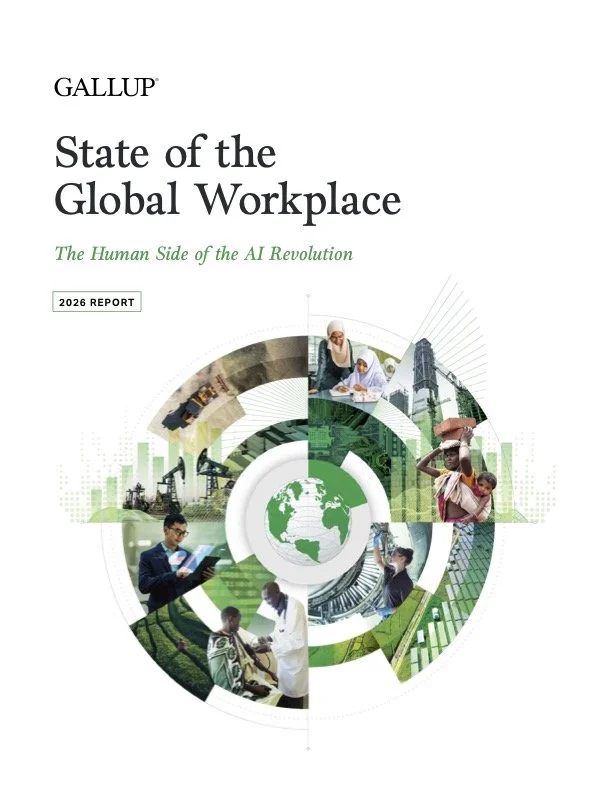
Gallup’s 2026 State of the Global Workplace  report came out this month, and one finding stopped me in my tracks: Managers are struggling more than almost anyone else.
They’re significantly more likely than individual contributors to feel stress, anger, sadness and loneliness on a daily basis. Even more telling—they’re less likely to say they felt enjoyment or even laughed the day before.

It’s hard not to connect that to another stat in the report: Overall employee engagement is now at its lowest level since 2020.

Because when the people setting the tone for a team are running on empty, it doesn’t stay contained. It ripples.

And yet, I don’t think this is a hopeless story. It’s a clarifying one.

The role changed. The support didn’t.

For a long time, being a manager came with what Gallup called an “engagement premium.”
Yes, the job was hard—but it also felt meaningful, connected, worth it.

That equation is breaking down.

Since 2022, manager engagement has dropped sharply. Last year alone, it fell from 27% to 22%. Managers are now only slightly more engaged than the people they lead.

But the emotional load of the role hasn’t decreased. If anything, it’s expanded.

Managers today are expected to lead through constant change, support wellbeing, implement new technologies, navigate hybrid environments—and still deliver results. Often with larger teams and less support.

It’s not surprising that many are starting to feel stretched past capacity.

The Part We Don’t Talk About Enough

One of the quieter themes in the data is isolation.

Managers sit in a difficult middle space. They can’t fully open up to their teams. They don’t always feel safe being candid with their own leaders. Over time, that can turn into a kind of professional loneliness.

I see this often in my work. People who care deeply about their teams, quietly carrying more than they should.

And eventually, the role that once felt purposeful starts to feel heavy.

The Hopeful Part (Because There Is One)

Here’s the piece of the data that changes the conversation:

When managers are engaged, those same negative emotions—stress, anger, loneliness—don’t just decrease. They drop below the levels of the people on their teams.

Engagement becomes a kind of buffer. A source of resilience.

But it’s not something you can simply ask someone to “try harder” at. It comes from the environment around them.

And that means it’s something we can actually influence.

What Actually Helps Build Manager Engagement

In my experience, three shifts make a real difference:

1. Start with wellbeing—not performance.
If someone is at their breaking point, no training or initiative will land the way it’s intended to.
Sometimes the most important first step is simply asking, “How are you really doing?”—and being willing to adjust based on the answer.

2. Reduce the isolation.
Managers need space to be honest without consequences. Small peer groups—where people can share challenges and compare notes—can be surprisingly powerful. Not because they solve everything, but because they remind people they’re not the only ones navigating impossible tradeoffs.

3. Get clear on what matters most.
One of the biggest drains on energy is feeling pulled in too many directions. When managers can focus on the few areas where they make the biggest impact, something shifts—for both effectiveness and motivation.

None of this is complicated. But it does require intention—and support from above.

What the Best Organizations Do Differently

Gallup found that in organizations that treat engagement as a long-term strategy, 79% of managers are engaged. Nearly four times the global average.

That gap isn’t about hiring better people. It’s about creating better conditions.

These organizations invest in development that meets managers where they are. They prioritize connection, not just content. And they treat manager wellbeing as something foundational—not optional.

A Different Question to Ask

We’ve spent years asking managers to do more for their teams:

Engage them. Support them. Lead them through change.

All of that still matters.

But this report raises a more important question:

Who is doing that for the managers?

If this is something you’re seeing in your organization, you’re not alone—and it’s not something you have to solve from scratch.

This is the work we’ve been focused on for the past 17+ years: helping managers lead through complexity without burning out in the process.

If you’re curious, I’m always open to a conversation. You can reach me at neena@newberrysolutions.com or explore more at www.newberrysolutions.com.


Don’t wait for performance to drop before taking action. Discover how the New Lens® platform helps organizations support managers with bite-sized, actionable learning—built for today’s fast-paced, high-stress environments.

Women and Burnout: Why It Happens, What to Do

This Women’s History Month, I can’t help but think about all the women leaders who are exhausted but still showing up. Who are carrying more than their share and wondering if anyone notices. Who love their work but aren’t sure how much longer they can sustain this pace.

Image by Pexels from Pixabay

To those leaders: I see you. 

Your fatigue is real, and it’s not a personal failing—it’s a systemic issue that organizations need to address. In one recent survey, 75% of women reported experiencing burnout at work, compared with 58% percent of men. Sixty percent of senior-level women report frequent burnout, compared with 50% of senior-level men. For Black women in senior leadership, that number climbs to 77%.

To the executives and HR leaders reading this, the burnout gap won’t close on its own. And it’s costing your organization dearly. You’re losing talent, engagement, and the leadership pipeline you’ve worked so hard to build.

So, as we celebrate women in March, we also must take a hard look at the barriers to women’s progress. The burnout crisis is one of the most serious obstacles women face, but also one where we can take decisive action.

Why Burnout Hits Women Harder

What’s behind these numbers? First, there are key factors driving burnout for men and women: stressful work environments, pressure from growing workloads, expectations to be constantly productive, stagnating wage growth and not enough mental health support.  Second, women face unique challenges that increase the risk of them feeling unprepared or overwhelmed in their roles:

  1. Women receive less actionable feedback than men—and less feedback overall. One analysis found that women get twice as many vague, unactionable critiques in performance reviews as their male colleagues, and are more than 20% less likely to receive the kind of difficult, specific feedback that actually helps people grow, learn and advance. 

  2. Women are less likely to be offered the stretch assignments and training opportunities that signal the organization’s investment in them and reinvigorate their career energy. Four in 10 entry-level women haven’t received a promotion, stretch assignment or leadership training opportunity in the past two years, and women are 12% less likely than men to receive leadership skills training.   

  3. Women experience the draining toll of microaggressions—being talked over in meetings, having their competence questioned, navigating double standards about leadership style. Women who experience microaggressions at work are four times more likely to report being almost always burned out. And women of color face these experiences at dramatically higher rates: Black women are nearly four times as likely as white women to encounter microaggressions, and Latinas and Asian women are two to three times as likely.

  4. Women often carry invisible labor that doesn’t show up on any performance review. Research shows that women in senior leadership do 60% more work than their male counterparts to support employees’ emotional well-being: mentoring junior colleagues, mediating team conflicts, noticing when someone is struggling. The culture-building work that organizations depend on falls disproportionately on women.

  5. Women still perform a disproportionate share of unpaid labor at home: Those who work full time still log 9.7 hours per week on household tasks, compared with 5.4 hours for men. Working mothers put in 63% more time than working fathers on childcare and housework each week. And beyond the physical work, mothers take on roughly 73% of all cognitive household labor—the never-ending work of planning meals, scheduling appointments and tracking what the family needs. When this “second shift” follows women into the office each morning, is it any wonder we are exhausted?

The #1 Misconception About Women and Burnout

We have to realize that burnout is not simply a result of individual choices. It is a systemic issue.

Far too often, we talk about women and burnout only in terms of what individual women can do on their own to recover. Addressing burnout at your organization involves more than, say, offering a weekly yoga class or a workshop on resilience.

That means that if your people seem burned out, examine workloads before you look for ways to build their stress management skills. Trust me, even the best training programs won’t be effective when your learners are just trying to keep their heads above water.

Workplace relationships are another systemic factor in burnout. Amid the rise of hybrid work and wave after wave of layoffs, it can feel harder than ever to form close connections to colleagues. More women than men feel isolated and lonely at work, and that fuels burnout.

Organizations also inadvertently fuel burnout by skimping on recognition. It’s easy to understand why: When we’re busy, praise and recognition can be among the first things to fall by the wayside. And—you guessed it—women get less recognition than men do.

How Development Can Address Women’s Burnout

As your organization examines structural issues that fuel burnout, you can start looking at how development opportunities fit into the equation. At Newberry Solutions, we’ve been working with high-performing women leaders since 2008, and we shape all of our products and services based on what really works.

Development must sustain, not drain. That’s why we emphasize teaching practical, immediately actionable strategies that focus on what matters most. We also created the New Lens® platform that empowers leaders to learn wherever they are, even when they have only a few minutes between meetings or in the school pick-up line. As one participant told us, “I feel like I’ve got four full-time jobs. What I love about New Lens is that I can work on it in between things in little spurts. It’s great how digestible this is—videos are two to seven minutes and the articles are short.”

To cultivate the relationships that benefit women so much, we offer development programs that integrate cohort learning, coaching and feedback, and build sponsorship—without taking too much time. All of this has the potential to fix the “broken rung” in women’s career advancement.

Empower Your Women Leaders

Since the turn of the decade, we’ve all been through enormous change, and disruption is only increasing. The period between now and 2030 will be unlike anything we have ever seen. Amid this dramatic transformation, there’s widespread anxiety about leadership pipelines. More than three-quarters of CHROs worry about their organization’s bench strength for key roles. 

In this environment, we just can’t afford to keep losing high-performing women to burnout. If this issue has been on the back burner at your organization, there’s no better time than Women’s History Month to move it forward. We love supporting organizations in advancing women in leadership—and we have an array of proven solutions to customize to your organization’s unique needs. Just drop us a note to open the conversation.


Don’t wait for performance to drop before taking action. Discover how the New Lens® platform helps organizations support managers with bite-sized, actionable learning—built for today’s fast-paced, high-stress environments.